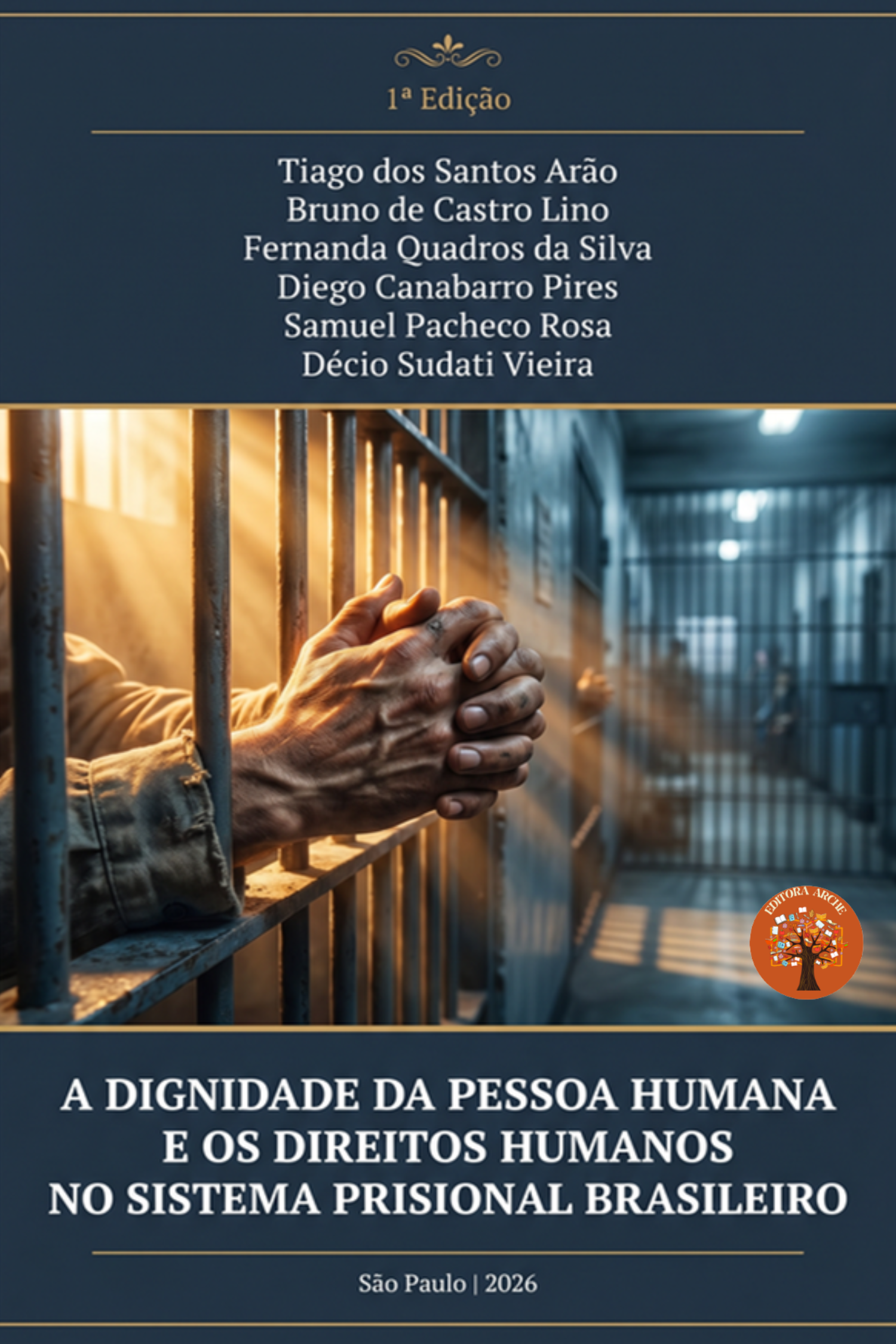
THE DIGNITY OF THE HUMAN PERSON AND HUMAN RIGHTS IN THE BRAZILIAN PRISON SYSTEM
Keywords:
Criminal Enforcement. Human Dignity. Prison System.Abstract
The principle of the dignity of the human person constitutes one of the founding pillars of the Brazilian Democratic State of Law, as stipulated in Article 1, item III, of the 1988 Federal Constitution. This normative postulate establishes that state action must necessarily safeguard the physical, moral, and psychological integrity of the individual, regardless of their legal status. In the ecosystem of the penal system, this principle ceases to be merely an ethical guideline and becomes an objective duty of care and oversight.
Penal execution represents, perhaps, the field of greatest tension for the applicability of these rights. The deprivation of liberty, a sanction imposed by the State, must be strictly restricted to the right of movement, not authorizing the suppression of the convict's status as a subject of rights. On the contrary, by assuming custody of the individual, the State assumes full responsibility for their safety, transforming the prison environment into a thermometer of democracy itself.
However, the reality of the Brazilian penitentiary system reveals a chasm between the constitutional text and daily practice. The scenario is marked by what the Supreme Federal Court has already characterized as an "Unconstitutional State of Affairs" (ADPF 347), where chronic overcrowding, the structural precariousness of the units, the scarcity of social reintegration policies, and the influence of criminal groups hinder the guarantee of basic rights and the very security of the prison operation.
This analysis is not intended to be a merely theoretical or external study; it is the result of the reflection of Prison Police Officers who work directly on the "ground floor." The perspective adopted here, therefore, carries the biases and colors of those who experience the system from the inside, which gives the work a dual dimension:
The first is what we call the Security vs. Welfare Bias: As public security operators, the authors face the daily dilemma between maintaining disciplinary order and guaranteeing humanitarian assistance. The perspective is conditioned by the need for surveillance and control, but also by the direct perception of the State's failures that reverberate both in the life of the prisoner and in the mental health of the officer.
Nevertheless, it is necessary to mention The Experience of Confinement: There is a bias of proximity. The Prison Officer, although not deprived of his legal freedom, shares the environment of confinement, the unsanitary conditions, and the constant tension of the system. This "immersion" allows for the identification of nuances of rights violations that escape the eyes of external researchers. The reflection presented here is permeated by professional pragmatism. The bias is that of seeking solutions that are feasible within a reality of scarce resources, where the dignity of the human person is not just an abstract concept, but a tool for stabilizing the work environment.
In this complex scenario, this work seeks to critically analyze the functioning of the Brazilian prison system, confronting fundamental guarantees with operational reality, from the perspective of those who have the legal duty and the ethical challenge of mediating punishment and dignity. This research is characterized as a qualitative and exploratory study, structured from a dialectical approach that confronts legal dogmatics with the operational reality of the Brazilian prison system. The substance of this work lies in the convergence between the theoretical-normative survey and the professional experience of the authors as Prison Police Officers.
To support the analysis, the investigation was divided into two complementary fronts:
1. Bibliographic Research: A review of classical and contemporary literature was carried out, encompassing the Philosophy of Law (especially the Kantian matrix of human dignity) and Critical Criminology (focusing on Alessandro Baratta and Michel Foucault). This theoretical basis allowed the construction of a critical framework on punitive power and penal selectivity.
2. Documentary and Statistical Research: Official documents and fundamental legal frameworks were analyzed, such as the 1988 Federal Constitution, the Penal Execution Law (LEP), and the judgment of ADPF 347 (STF). The quantitative basis was extracted from institutional reports from the National Secretariat of Penal Policies (SENAPPEN) and the National Council of Justice (CNJ), with a temporal focus on data from 2024.
The methodological difference of this work lies in the unsystematic participant observation resulting from the professional activity of the researchers. Unlike a merely external analysis, the interpretation of the data presented here is mediated by the "place of speech" of the Prison Police Officer.
In this way, the methodology adopts a reflective character, where the object of study (the prison system) is analyzed by subjects who make up the state custody structure. This made it possible to identify what the doctrine calls the "gap between
Downloads
Downloads
Published
How to Cite
Issue
Section
Categories
License
Atribuição CC BY
