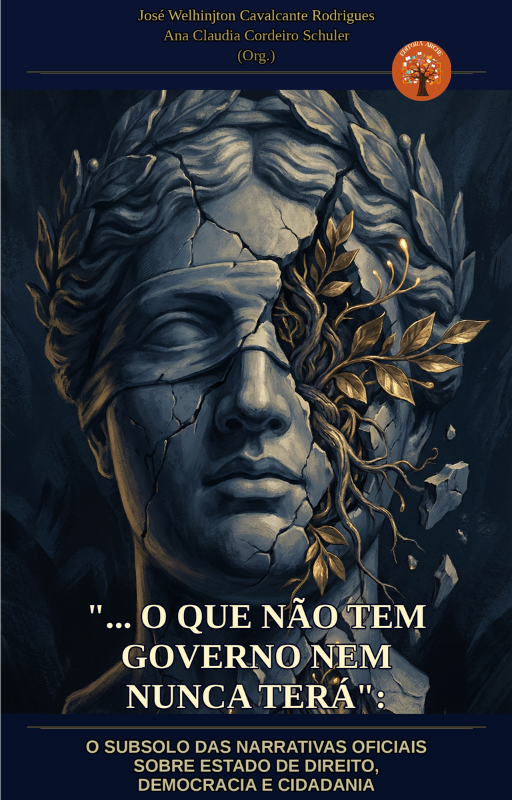
"...WHAT HAS NO GOVERNMENT AND NEVER WILL": THE UNDERGROUND OF OFFICIAL NARRATIVES ABOUT THE RULE OF LAW, DEMOCRACY, AND CITIZENSHIP
Keywords:
Democracy and the Rule of Law. Human Rights. Social Inequalities and Selective Criminal Justice.Abstract
Greetings to the readers!
It is with satisfaction and joy that I present this work, a collaborative effort involving many dedicated reflections on critical and, at times, uncomfortable aspects of Law. I confess that, upon receiving the invitation to present this work, I was immediately captivated by the title due to its reference to the song "O que será" by Chico Buarque, a song originating from the context of the military dictatorship in Brazil, in which the "unspoken" and the "unnamable" were forms of expression and subversion.
In the current political context, "what they are plotting in the darkness of their dens" has revealed conspiracies culminating in episodes such as the one that occurred on January 8, 2023, with the invasion of the National Congress by a group of people who called themselves patriots. Such a collective "patriotic" delirium should appear in future history books of Brazil as an attack on democracy and the established powers of the State.
It seems unthinkable that almost 40 years after a process of redemocratization of the Brazilian State, in which the horrors of the military dictatorship were experienced in the country, we still have to fight for democracy, while the extreme right, in the "fantasy of the unfortunate," insists on historical denialism by treating this period as successful in our history.
The late jurist Paulo Bonavides had already invited us to these thorny debates when he argued that the rule of law is a state of justice, not of blind obedience to the laws, since unjust laws would not necessarily guarantee the protection of citizens' rights and, precisely for this reason, a defensible democracy is a participatory one that articulates and implements a constitutionalism of struggle, resistance, offense, and liberation that must be present in the national consciousness.
In this sense, the proposal of this book arises in this political context in which it is necessary to say, reflect on, and defend the obvious, because discussing citizenship, democracy, and the rule of law in the face of an offensive against the powers and their structures in the praxis of the extreme right is urgent and at the same time challenging. This challenge was successfully undertaken by Professor José Welhinjton Cavalcante Rodrigues and Master's student Ana Claudia Cordeiro Schuler in bringing together these texts during this chaotic political and legal period.
The professor and the Master's student took care and dedication in compiling texts developed during the course "Political Development: Rule of Law, Democracy and Citizenship" of the Master's Program in Legal Sciences at Veni Creator Christian University, in which students and professors were able to express their concerns about central issues affecting the full exercise of citizenship, the contradictions of blind obedience to the rule of law, and the challenges of democracy in a racist, patriarchal, classist, and, above all, unequal society.
As a professor, like José and Ana Cláudia, I can say that we feel very proud and a sense of accomplishment when our students present texts that sometimes even exceed our expectations of reflection and depth in articulating the concepts studied in class with a critical reading of social, political, and legal phenomena.
The first chapter, entitled "The Invisible Borders Against Women in the Labor Market," by Ana Claudia Cordeiro Schuler, Fernanda Falcão do Nascimento, and José Welhinjton Cavalcante Rodrigues, presents a discussion on the difficulties of women's advancement and opportunities in the labor market from an intersectional perspective, focusing on these obstacles as perceived by Black working-class women, considering historical, sociological, and legal perspectives.
The second chapter, "Digital Threats to Critical Female Voices: The Jacqueline Muniz Case and the Erosion of the Rule of Law," developed by Andréa Tavares Colaço de Souza, Juliana Vieira de Barros, and José Welhinjton Cavalcante Rodrigues, exposes this new form of political and epistemic violence against women, particularly intellectual women who occupy public spaces. To exemplify this situation, the authors analyzed the case of Professor Jacqueline Muniz, a political scientist and professor at the Federal Fluminense University (UFF), specializing in Public Security, who suffered virtual attacks and a deliberate campaign of hate, disinformation, and threats after presenting a paper with technical and critical analyses of the joint operation of security forces in the Penha and Alemão complexes in October 2025.
In the following chapter, entitled "Precariousness as a Foundation of Human Rights," written by Ana Paula de Vasconcelos Coura, Paula Carolina Dos Santos Monteiro, and José Welhinjton Cavalcante Rodrigues, the authors, by overcoming the bases of universality and vulnerability of human rights, present other markers such as precariousness, which can contribute to the debate on the reconstruction of human rights, highlighting political inequalities and the occupation of public space by different groups.
The notion of precariousness thus contributes to a process of reconfiguring human rights, balancing asymmetries and promoting equality for historically excluded groups.
(The text abruptly ends here, so the translation also ends here.) "From 'Call Girl' to 'Job Woman': (De)humanization from the Perspective of Critical Feminism," which titles the 4th chapter by Daniel Pimentel Pinheiro, Tiago Martins Freire, and José Welhinjton Cavalcante Rodrigues, presents an analysis of the historical trajectory between prostitution and feminism and how, over time, the commodification of the female body has taken on new forms with the development of the capitalist system. Despite the social invisibility of women in prostitution, there are differences between "call girls" and "job women."
Chapter 5, written by Rozeane Leal do Nascimento and José Welhinjton Cavalcante Rodrigues, entitled "Racial Issues and the Incarceration of the Black Population: Historical Notes on the Origins of Penal Selectivity," points out and analyzes the phenomena intertwined in the relationship between racial issues and the access of the Black population to fundamental rights, particularly in the prison system, and how "target skin" has become a priority. in the occupation of prisons alongside the difficulties of access to justice for the Black population in Brazil.
Raphael Albuquerque Fernandes, Raquel Tavares Miranda Maciel, and José Welhinjton Cavalcante Rodrigues, in chapter 6 "Gender, Punishment, and Power in the Brazilian Penal State," present a reflection similar to that addressed in the previous chapter, broadening the scope on the issue of gender and socioeconomic condition, in which the neoliberal and patriarchal context functions in punitive policies as a driver of moral and economic regulation, falling, above all, on Black and poor women.
Along the same lines of reasoning on punitive selectivity, in the following chapter: "Police, Selectivity, and Citizenship" by Adriana Magalhães Lima Rolim and Gilvan Rios Lins Junior, the authors analyzed how this police selectivity interferes with the exercise of fundamental rights, citizenship, and the realization of rights, especially for those groups that are already vulnerable, questioning the effectiveness of constitutional principles and the foundations of the Democratic Rule of Law.
“Restorative Justice and Peacebuilding Circles as a Decolonial Force” is the title of the eighth chapter of this work, written by Cristiane Cavalcanti Dutra de Lima and José Welhinjton Cavalcante Rodrigues, in which the authors analyze the historical origins of Restorative Justice and Peace Circles from their primary basis, community and ancestral practices, thus distancing themselves from the appropriation of these practices by the neoliberal system and the colonial thinking that underlies it. To reclaim this perception of these instruments is to adapt them to the sociocultural reality of Brazil and to distance themselves from the colonial legacy that surrounds it.
In “Penal Selectivity and Mass Incarceration as an Expression of Social Inequality,” Rafael Teotônio Barbosa, Valnete Lima do Espírito Santo, and José Welhinjton Cavalcante Rodrigues examine Brazil's punitive model and how markers of socioeconomic and racial inequality operate within this model. In this analysis, the authors highlight the interrelationships between structural racism and the justice system. Criminal law and economic exclusion contribute to selective prosecution and incarceration, further marginalizing historically marginalized and vulnerable groups in our country.
In the last chapter, Eugenio Pacelli Barbosa de Melo Porto and José Welhinjton Cavalcante Rodrigues discuss "Abortion and Vulnerability in the Rule of Law," proposing an interdisciplinary analysis considering the ethical, philosophical, social, and legal perspectives involved in this debate. To this end, the authors analyzed the Argument of Non-Compliance with Fundamental Precept No. 442, pending before the Supreme Federal Court since 2017, which provokes discussion for the decriminalization of abortion as a matter of human dignity, gender equality, and the realization of fundamental rights. However, the opposing and predominant discourses in our society reinforce the patriarchal society's need for control over women's bodies and lives.
This was a brief tour through the chapters of this book to encourage readers to read it attentively. These high-quality texts offer critical discussions of legal, social, and political phenomena and problems of our time, and problematize the exercise of citizenship, exposing the fragility of our democracy and the limits of the rule of law.
And as Paulo Freire already encouraged us to hope, we must understand that academic writing is also a space of struggle because it instigates us to the dialectical path for critical reflection on "truths" that have been imposed on us and the countless possibilities of collective construction and the subversion of the coloniality of knowledge.
Happy reading!
Prof. Dr.
Josilene Ferreira Mendes, February 2026
Federal Rural University of the Amazon
Downloads
Downloads
Published
How to Cite
License
Atribuição CC BY
