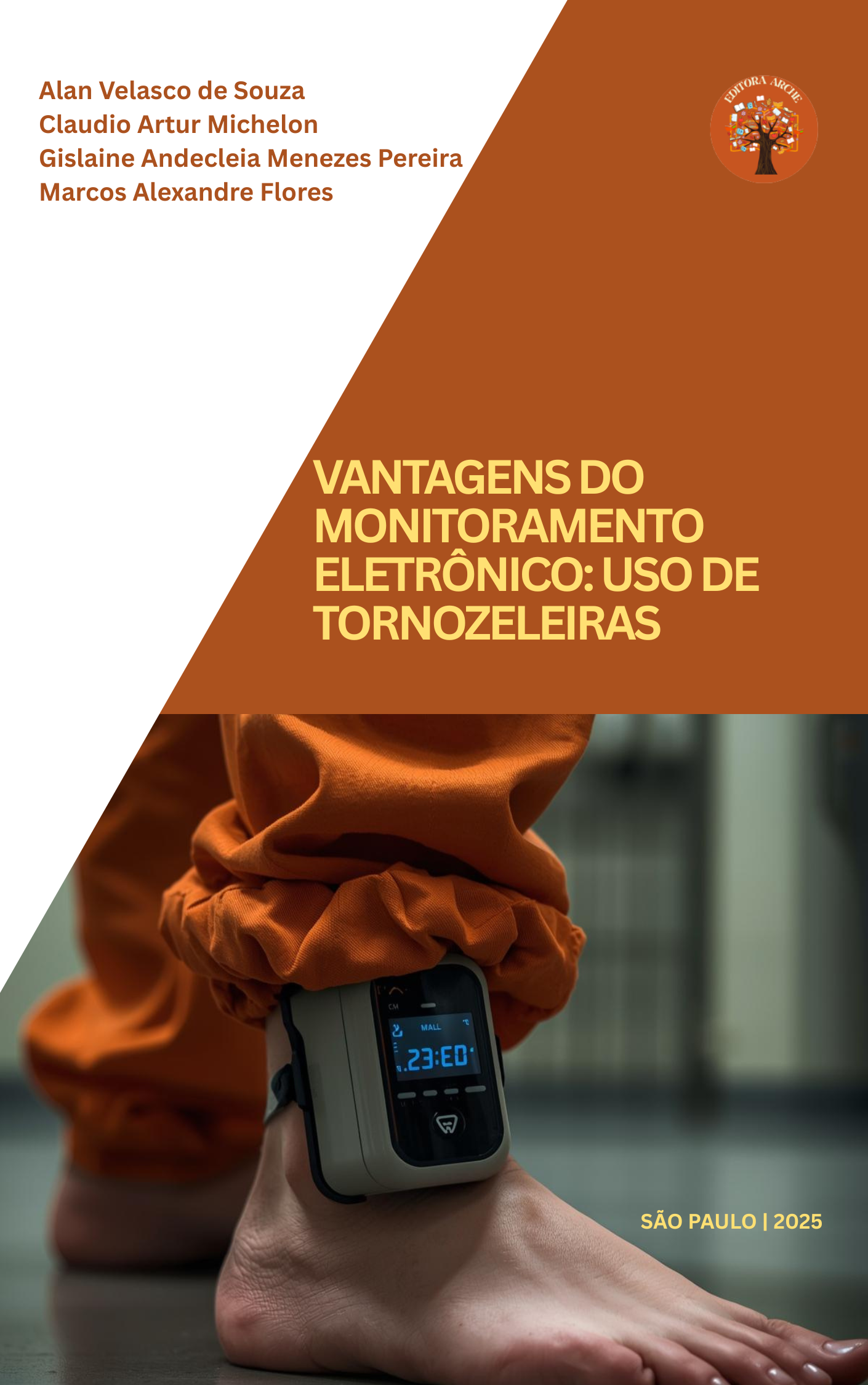
ADVANTAGES OF ELECTRONIC MONITORING: USE OF ANKLE BRACELETS
Keywords:
Electronic Monitoring. Anklet; Law 12.258 / 10.Abstract
The chosen theme falls within the area of Criminal Law and focuses on the recent debate regarding electronic monitoring in the execution of sentences. In light of the recent amendment to the Code of Criminal Procedure by Law No. 12,403 of May 4, 2011, electronic monitoring, already widely used in other countries, was transplanted into our legal system as a precautionary measure other than imprisonment, in Article 319, item IX, of the aforementioned procedural criminal law. However, electronic monitoring is also provided for in the national legal system through the Law on Criminal Execution, as a form of supervision in the fulfillment of sentences, such as temporary releases and house arrests. The electronic monitoring system is done through a GPS signal, which stands for Global Positioning System, through which it is possible to know the exact location of the individual on the planet. Regarding the method of adaptation for users, there are currently four technical options for electronic monitoring: the bracelet, the ankle bracelet, the belt, and the microchip implanted in the human body.
Electronic monitoring is applied systematically and with great success in several countries, such as the United States of America, Canada, England, Portugal, Italy, Germany, Scotland, Sweden, Switzerland, the Netherlands, France, Australia, Wales, Andorra, New Zealand, Singapore, Belgium, Israel, Taiwan, South Africa, and, in Latin America, Argentina. In Brazil, due to its recent incorporation into our legal system, the use of electronic monitoring is incipient and is being used experimentally in the states of Rio de Janeiro, São Paulo, Rondônia, Paraíba, Pernambuco, Alagoas, the Federal District, Minas Gerais, and Rio Grande do Sul.
The importance of studying this topic can be corroborated by the constant news reports in the media about the failing state of the Brazilian prison system. Indeed, penal establishments are overcrowded, first-time offenders or those held in pretrial detention are mixed with highly dangerous convicts, and sometimes end up becoming even more involved in crime, resulting in extremely high recidivism rates. It is clear, therefore, that this serious public safety problem distorts the very purpose of the sentence imposed on the convict, as it becomes a mere instrument of punishment and segregation of the individual, without any intention of resocializing the criminal and preparing them to return to society.
In this context, this research seeks to problematize, from theoretical aspects and practical experiences, the following questions: 1) Is electronic monitoring a viable and effective alternative to incarceration? 2) What is the impact of electronic monitoring on reducing recidivism rates among criminals?; 3) Does electronic monitoring contribute to the resocialization of criminals through their gradual reintegration into society?
It is imperative to break the vicious cycle that is entrenched in the Brazilian penal system, according to which the same individuals enter and leave prisons, each time committing increasingly serious offenses and distancing themselves from their status as citizens and the rights and duties inherent to it. On the other hand, it cannot be overlooked that the topic of electronic monitoring is surrounded by heated controversies and extensive discussions, largely because it is an instrument used in few states and has only recently been authorized in the Brazilian legal system.
Indeed, the initial discussion revolves around the human rights of citizens subject to electronic monitoring, as a doctrinal current led by Maria Lúcia Karam argues against its use, claiming that it would lead to undue exposure of the convicted person, violating their dignity and privacy. The problematic nature of this issue is quite broad, as questions arise regarding the costs of implementing the system versus the costs of maintaining individuals in prison, as well as the effectiveness of monitoring from a public safety perspective, encompassing both its purpose and the increasingly sought-after resocialization effect.
Throughout my professional career in public security, I have observed the serious problem of the failing Brazilian prison system. This has always significantly hampered the effectiveness of our work, as the insufficient number of spaces in penal institutions meant that inmates remained overcrowded and in poor conditions, even in police vehicles, eliminating any possibility of their rehabilitation. This issue frequently led us to divert our attention from proper judicial duties to deal with rebellions, escapes, lack of space for defendants in penal institutions, and the absence of minimum conditions in police station and prison holding cells.
On the other hand, faced with this reality, there is no alternative but to release prisoners who are not ready for reintegration into society, and these individuals often reoffend or escape before the process is completed. After a group of Brazilian magistrates participated in an exchange program in the State of Georgia (USA), focused on the study of the American legal system, the opportunity arose to observe firsthand and analyze statistics on the successful use of electronic monitoring of prisoners in the American system, a fact that sparked great interest in the institution. Thus, when the amendments to the Code of Criminal Procedure came into effect, which followed the trend of making the incarceration of defendants an exception and introduced the express provision for electronic monitoring, a light at the end of the tunnel was glimpsed in the search for a solution to the public security problem related to prison overcrowding. The topic chosen for this work is therefore pertinent to Criminal and Criminal Procedure Law, as it seeks to contribute to solving the problem of prison overcrowding and high rates of recidivism, as well as the insufficient number of places in establishments suitable for housing those sentenced to semi-open regimes. It is important to emphasize that a prisoner costs the public coffers approximately R$ 1,800.00 (one thousand eight hundred reais), while the cost of electronic monitoring per person is R$ 240.00 (two hundred and forty reais) to R$ 600.00 (six hundred reais) per month, according to official information from the National Penitentiary Department (Depen).
According to the National Penitentiary Department (Depen), the responsibility for implementing the electronic monitoring system lies exclusively with the states, which have autonomy to define the model, methods, and convenience of its adoption. Therefore, this research aims to analyze the feasibility of implementing this system in the state of Rio Grande do Sul, considering data such as prison population and expenses related to prisoners. It is observed that, having been introduced only recently into the Brazilian legal system, there are few studies on the subject in Brazil, making it necessary to resort to foreign bibliography as a theoretical basis for the research. Thus, this study also aims to contribute to expanding the production of knowledge on the chosen topic.
National doctrine on the chosen topic is extremely limited, as it was only recently introduced into the Brazilian legal system. Our basic theoretical foundation will be Law No. 12.258, of June 15, 2010, and the Penal Execution Law, as these two legal instruments introduced the institution of electronic monitoring into the Brazilian legal system. It is evident that, prior to the entry into force of the aforementioned new legal instruments, any work developed on electronic monitoring would have to remain restricted to the purely theoretical plane, due to the legislative obstacle to its practical implementation and consequent observation of results.
Downloads
Downloads
Published
How to Cite
License
Atribuição CC BY
