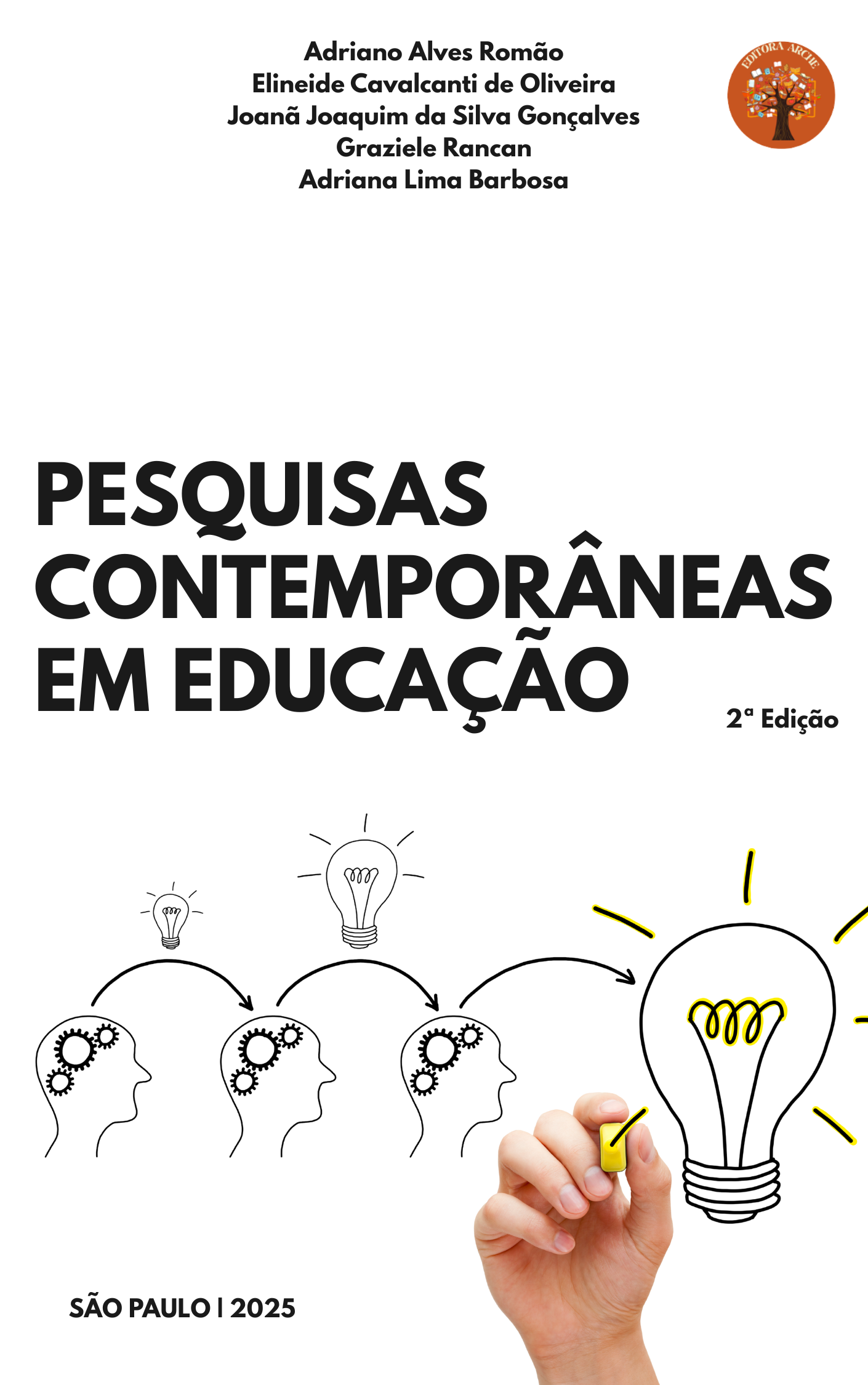
CONTEMPORARY RESEARCH IN EDUCATION
2nd Edition
Keywords:
Inclusion. Contemporary education. Pedagogical innovation.Abstract
We live in a time of intense educational transformations, in which pedagogical practices must engage with diversity, inclusion, innovation, and the constant pursuit of quality. This book brings together reflections and studies that address fundamental themes for reflecting on contemporary education in its multiple dimensions, offering theoretical and practical support for professionals committed to building a more meaningful, sensitive, and up-to-date teaching environment.
The book begins with an analysis of the use of digital games in virtual learning environments, highlighting their potential as a motivating and interactive tool. In a scenario where student engagement is one of the greatest challenges in teaching, reflecting on technologies applied to teaching is an urgent need.
The book then discusses the role of active methodologies and collaborative practices, emphasizing how student empowerment can be strengthened through peer exchange and the collective construction of knowledge. Learning ceases to be a solitary process and becomes a shared and more engaging experience.
Another highlight is the debate on quality management in education, addressing obstacles and strategies within the context of educational institutions. It is clear that achieving educational quality requires more than infrastructure: it requires planning, active listening, community participation, and a focus on teacher training.
The curriculum, a central element of pedagogical practice, is also a topic of in-depth study. The book presents reflections on the principles of the National Common Curricular Base (BNCC) and its impact on the Brazilian curriculum, highlighting both the potential and challenges of its implementation in different educational contexts.
Attention to diversity is strongly emphasized in two chapters specifically focused on inclusion. One analyzes the importance of curricular adaptation and the use of specific methodologies in special education, considering the needs of students in the early grades. The other addresses the challenges faced by blind children in the teaching-learning process, reinforcing the importance of accessible and welcoming pedagogical practices.
By bringing together different perspectives and experiences, this work offers a critical and purposeful reading of educational practices. It invites reflection on how to make schools more democratic, innovative, and committed to everyone's learning. May these pages inspire real transformations in classrooms, curricula, and teaching and learning practices.
Downloads
Downloads
Published
How to Cite
License
Atribuição CC BY
