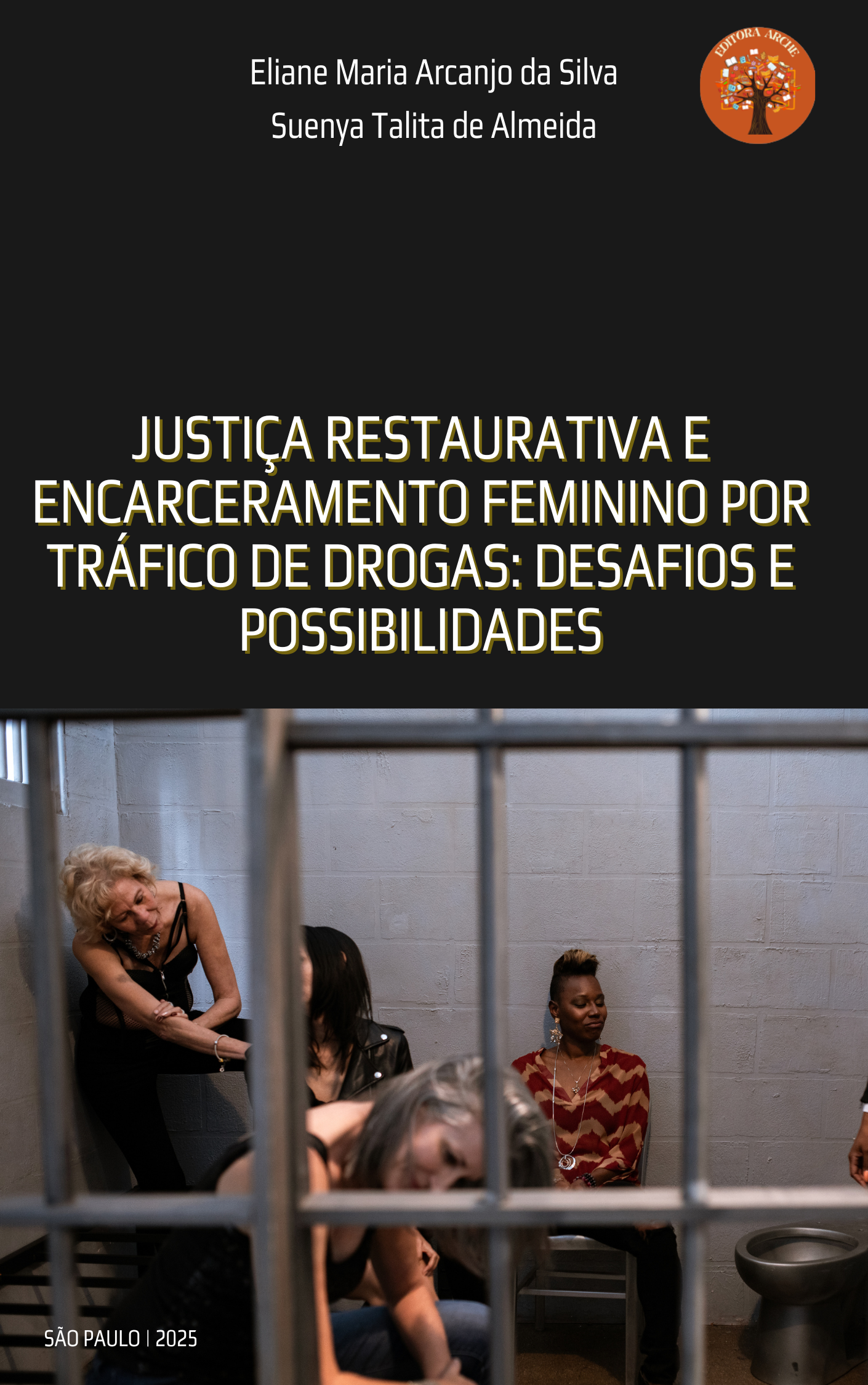
RESTORATIVE JUSTICE AND FEMALE INCARCERATION FOR DRUG TRAFFICKING: CHALLENGES AND POSSIBILITIES
Keywords:
Penal system. Women prisoners. Gender-based violence. Drug trafficking. Restorative approach.Abstract
The growing crime rate linked to drug trafficking in Brazil has intensified the recruitment of women for illicit activities, especially as drug transporters. This practice, which exploits female vulnerability in a context dominated by men, highlights the need for a more in-depth analysis of gender inequality in the penal system and the gap in research that intersects gender, crime, and justice. (WICHINHESKI, 2023).
Since the implementation of the prohibitionist policy to combat drugs in the 1980s, there has been an exponential growth in the repression of drug trafficking and, as a direct consequence, an alarming increase in the prison population on a global scale. In Brazil, the growing number of women incarcerated, especially for crimes related to drug trafficking, is a reflection of a sad reality: they are often the sole providers of support for their families, in a context of social vulnerability. Without access to formal education - 45% of prisoners did not complete elementary school (INFOPEN WOMEN, 2018) - these women find themselves without opportunities in the formal job market and, in some cases, susceptible to illicit activities to survive.
Although women represent a significant portion of the prison population, with a high rate of involvement in drug trafficking, they work in lower echelons of criminal organizations. And they generally play secondary roles, as transporters or small traders, and are often drug users. These women, who are in a vulnerable situation due to histories of violence, motherhood, financial issues and substance use, have specific demands and needs, as evidenced by data from INFOPEN (2018).
Cortina (2015) states that the data from her research show that the majority of women imprisoned for drug trafficking cite the need to support their children and the lack of job opportunities32 as the main reasons for getting involved in crime. This confirms the idea that, for many of them, trafficking is seen as a way to guarantee income. This situation is a reflection of the feminization of poverty, which makes women more vulnerable to social exclusion and leads them to make extreme decisions to survive.
The prison system, designed by and for men, does not consider the specific needs of women, perpetuating female marginalization and reinforcing gender stereotypes. The idea that women should not commit crimes and should limit themselves to the role of caregivers is deeply rooted in this system (COSTA, 2019).
When analyzing the situation of women incarcerated in Brazil in depth, it is clear that they face a series of challenges. Prisons, designed for men, do not take into account the particularities of the female universe, which makes them even more vulnerable. The lack of basic resources and emotional isolation intensify the suffering of these women, who are made invisible by society and treated inhumanely. This reality demands an urgent reform of the prison system, with a focus on human dignity and Restorative Justice (RJ) (WICHINHESKI, 2023).
According to Cortina (2015), drug trafficking is organized in a hierarchical manner, with men in charge. Women, in addition to being subjected to this inequality within crime, suffer even more when imprisoned, since prisons, designed for men, marginalize them. Critical and feminist criminology shows that the penal system, instead of combating crime, criminalizes certain people. Poor and black people, for example, are more susceptible to arrest for drug trafficking, even without concrete evidence. The lack of objective criteria and the subjective interpretation of elements such as location of approach and physical appearance contribute to this penal selectivity (GERMANO; MONTEIRO and LIBERATO, 2018). According to Santoro (2018), the current reality of the Brazilian prison system, marked by disregard for human rights, becomes even more cruel and inhumane when it comes to incarcerated women. The violations to which they are subjected in prisons are a terrifying portrait of the invisibility and marginalization that plague this segment of the population.
It is clear that mass imprisonment has proven to be an efficient policy for its purposes, with its effectiveness reversed [1] causing the social death of prisoners, difficulties in the resocialization process with its methods and structures depriving prisoners of their constitutional guarantees and rights, while producing a false sense of justice and security in society.
However, this apparent effectiveness is revealed to be a contradiction, since the most recent data from RELIPEN indicate that Brazil continues to have one of the largest prison populations in the world, demonstrating that mass incarceration is not a lasting solution to the problem of crime.
According to the latest Penal Information Report (RELIPEN), published by the National Secretariat for Penal Policies, an agency linked to the Ministry of Justice and Public Security and referring to the first half of 2024, Brazil has a prison population of 663,387 inmates, made up of 634,617 men and 28,770 women.
Given this scenario, the question is: How can restorative justice be an alternative to address the underlying causes of the criminalization of women and promote social reintegration, considering the gender specificities and the social and economic roots of this problem?
The analysis of this study is limited to drug trafficking crimes, due to the incidence of this type of crime in the incarceration of women, which, according to a survey by Infopen Mulheres, was 62% of the crimes for which women were imprisoned. This demonstrates the relevance of drug trafficking as the main cause of female incarceration (INFOPEN MULHERES, 2018).
The research proposal follows three stages for its development: (i) a relevant bibliographic survey, through searches in scientific, legal and doctrinal literature using inclusion and exclusion criteria for texts and cross-references; (ii) data analysis through content analysis by category; (iii) presentation of results using text.
Considering this reality, the 2018 study "Pilotando a Justiça Restaurativa" by the CNJ points to a significant expansion of restorative practices in Brazil. Currently, most federative units have restorative justice programs, whether in the initial phase or already consolidated. These initiatives cover several areas, from childhood and youth to criminal enforcement, including courts specialized in domestic violence and organized fan clubs. In addition, restorative justice has shown promise in spaces such as schools and municipal guards, demonstrating its potential to transform the culture of conflict resolution in the country (CNJ, 2018).
However, although the CNJ study demonstrates significant progress in Restorative Justice in Brazil, there is a clear need for new guidelines to address the particularities of vulnerable groups, such as women involved in drug trafficking. By identifying this gap, the research reinforces the urgency of public policies, proposing a reflection on the possibility of implementing restorative programs in this context.
According to Zehr (2008), Restorative Justice proposes a new way of viewing conflicts, a paradigm shift. Instead of focusing solely on the violation of the law, as traditional justice does, Restorative Justice directs its gaze to the people directly involved in the conflict and the consequences they caused. It is as if Restorative Justice invites us to change the lenses with which crime is analyzed, adopting a more humanized perspective focused on relationships between people.
According to analyses by Melo et al. (2023), Restorative Justice emerges as a promising approach to dealing with conflicts related to gender issues, both individually and collectively. By strengthening the victim's personal power and providing a safe space for dialogue, this practice allows those involved to transform conflicts, differences and offenses into opportunities for growth and strengthening of bonds. In addition, Restorative Justice indirectly contributes to the prevention of criminal recidivism.
Brazil, with one of the highest incarceration rates in the world, highlights the need for more humane and effective state plans to deal with criminal issues. In this context, Restorative Justice presents itself as a promising approach that seeks alternatives to traditional incarceration, prioritizing the reparation of damage and the social reintegration of individuals.
More than punishing, the Penal Enforcement Law - LEP (Law No. 7,210/1984) aims at the social reintegration of the convicted person, with a view to enforcing criminal sentences or decisions, providing harmonious conditions for the social integration of the convicted person and the inmate. The art. 1 of the aforementioned law determines that the custodial sentence must create conditions for the individual to be able to fully reintegrate into society (BRAZIL, 1984).
A survey conducted by the Vacancy Regulation Center, linked to the CNJ, found that in the period from 2011 to 2021 there were, on average, approximately 66% more prisoners than existing vacancies and that there is a tendency for the deficit of vacancies to increase, given the increase in arrest warrants. Furthermore, even if the creation of new vacancies is considered, this solution is far from ideal, since it is costly (CNJ, 2022).
Furthermore, according to the CNJ, the average monthly cost of a prisoner is R$1,800.00 (one thousand and eight hundred reais). Considering that in 2021 there were 680 thousand people deprived of liberty, the annual cost of maintaining the prison system is around R$ 14.7 billion per year (excluding the cost of creating new spaces). (CNJ, 2022).
In light of this problem, by offering alternatives to incarceration, Restorative Justice can contribute to reducing prison overcrowding and reducing costs related to maintaining the penal system.
Reintegration into society, despite being on the public safety agenda, has not yet translated into effective government actions, especially to reintegrate prisoners into society. Added to this is the disparity in care for incarcerated women, who, despite their growing numbers, receive similar treatment to men, which makes their reintegration into society even more difficult (SOUZA; COSTA and LOPES, 2019).
According to the Criminal Information Reports, published in December 2023 by the National Secretariat for Criminal Policies, linked to the Ministry of Justice and Public Security, in Pernambuco[2], the female prison population was 835 inmates, with convictions, while the inmates in provisional regime totaled 492 inmates in the state (BRASIL, 2023).
Given the alarming scenario of female incarceration in Brazil, with emphasis on the high rate of women imprisoned for crimes related to drug trafficking, this study becomes even more relevant. By analyzing the effectiveness of Restorative Justice as an alternative for these women, the research contributes to the field of Criminal Law and Criminal Sciences, by deepening the debate on RJ and its practical applications. By deconstructing stereotypes about women involved in trafficking and questioning the social construction of the "social risk" associated with them, we seek to contribute to overcoming an exclusionary penal model and building a more equitable and restorative criminal justice system.
[1] Inverted effectiveness means, then, that the latent and real function of the penal system is not to combat (reduce and eliminate) crime, protecting universal legal assets and generating public and legal security, but, instead, to construct it selectively and stigmatizingly, and in this process reproduce materially and ideologically, social inequalities and asymmetries (of class, gender, race)” (ANDRADE, 2014, p. 136).
[2] The choice of this federative unit is justified by its high rate of female incarceration and the need to deepen the understanding of the phenomenon in a specific context.
Downloads
Downloads
Published
How to Cite
License
Atribuição CC BY
