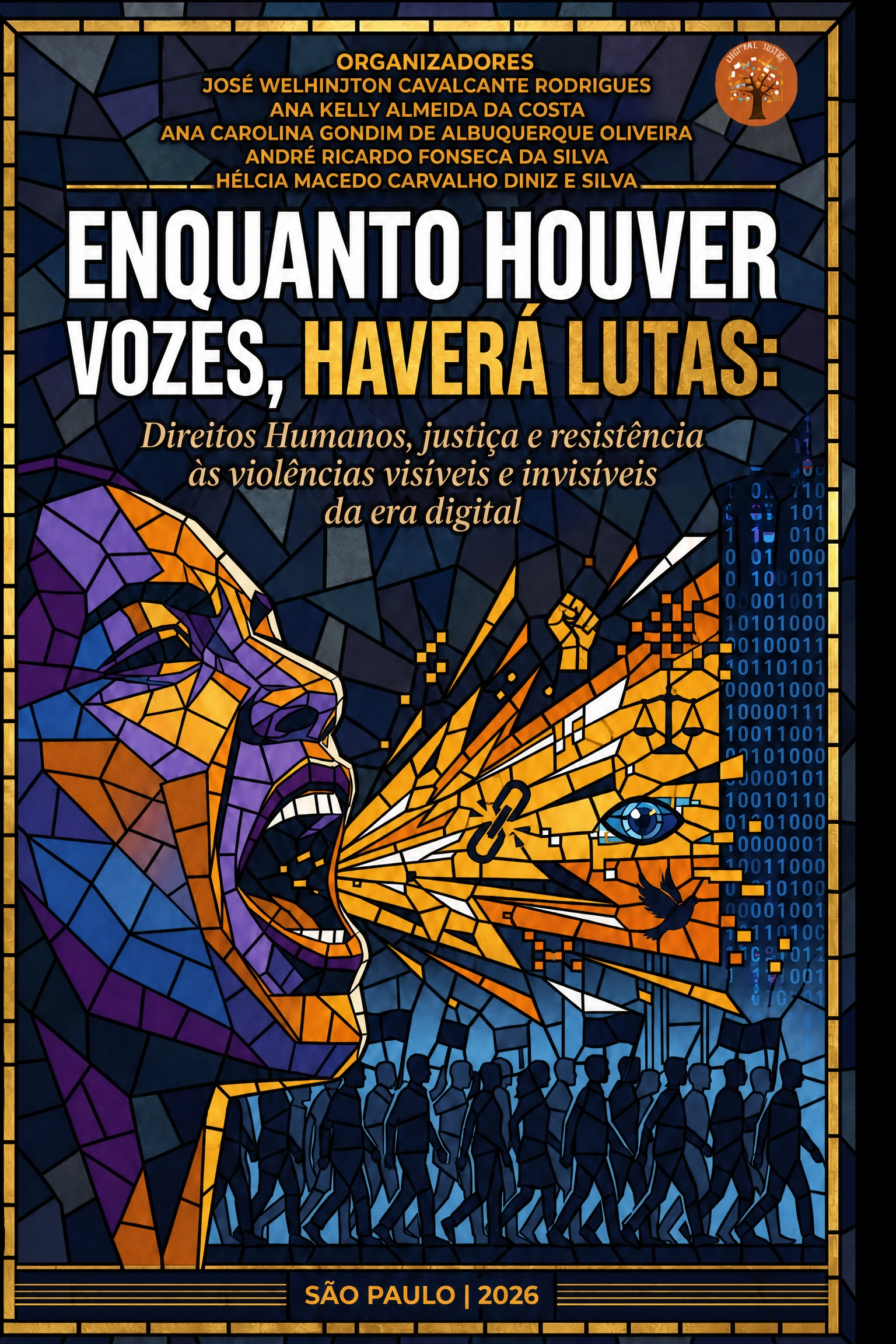
AS LONG AS THERE ARE VOICES, THERE WILL BE STRUGGLES: HUMAN RIGHTS, JUSTICE, AND RESISTANCE TO THE VISIBLE AND INVISIBLE FORMS OF VIOLENCE IN THE DIGITAL AGE
Keywords:
Human Rights. Digital Violence. Social Justice.Abstract
Far from being a neutral or purely instrumental space, the digital era has established itself as the new structural framework for contemporary political, social, and legal relations. While technological innovations—driven by ICTs (Information and Communication Technologies) and the expansion of the network society—promise to broaden channels of dialogue and streamline institutional procedures, they also bring to the fore old specters of oppression, now repackaged by algorithmic mechanisms. This collection, now presented to the reader, undertakes the fundamental and urgent task of mapping these visible and invisible forms of violence, providing an interdisciplinary diagnosis essential for considering the survival of human rights, citizenship, and resistance in the twenty-first century.
As a professor and researcher focused on the dynamics of public policy and human development, I understand that the advent of technology necessitates a profound redefinition of the State's role. Public policies in the digital society can no longer be conceived in static or merely analog terms. The lack of effective regulatory frameworks and public policies aimed at inclusion, digital literacy, and the protection of vulnerable groups results in the systematic production of what the authors of this work precisely identify as "mutilated citizenship," silencing, and ontological exclusion.
The book is structured around thematic axes that engage with one another through a sophisticated theoretical thread, drawing upon key thinkers—such as René Girard, Achille Mbembe, Michel Foucault, and Pierre Bourdieu—to shed light on the Brazilian reality.
In the first part of the book, the contemporary patriarchal backlash is analyzed through the lens of "manosphere" virtual communities and the "Red Pill" movement. The chapters demonstrate how the "crisis of masculinity" is instrumentalized on platforms like TikTok and Instagram, as well as in anonymous forums, to reconfigure gender-based domination, leading to a worrying rise in rates of violence against women. The analysis shifts, with equal rigor, to the realm of "digital parenting" and the phenomenon of "sharenting," taking the well-known case of content creator Felca as a starting point. Drawing on René Girard’s sacrificial theory and the biopolitics of childhood, the text reveals how the overexposure and monetization of minors transform the child's image into an engagement commodity, effectively turning the child into a kind of contemporary sacrificial victim of digital spectacularization.
Generative artificial intelligence technology and the proliferation of deepfakes are also subjected to in-depth investigation. The authors demonstrate how the technical capacity to fabricate synthetic identities undermines the ontology of the legal subject and exacerbates the exclusion of gendered and racialized bodies, challenging the protective framework of the LGPD (General Data Protection Law) and traditional civil liability regimes.
Contrasting due process guarantees with the viral speed of social media, the authors discuss the evolving nature of civil liability for digital influencers and the duty of care incumbent upon digital platforms—particularly following the Supreme Federal Court's modulation of the ruling on "Theme 987" (a case of general repercussion).
The second major focus of this collection turns to the internal workings of the justice system and its operational contradictions. The authors analyze the paradox of protection in cases of domestic violence, demonstrating—through accounts of actual cases involving court bailiffs—how the persistence of Lenore Walker’s "cycle of violence" hinders the practical effectiveness of the urgent protective measures established by the Maria da Penha Law. Symbolic violence is also examined through the lens of "legalese" in institutional practices. Excessive formalism and language that is incomprehensible to the public serve, in Pierre Bourdieu’s terms, as instruments of domination and of maintaining the "subservience of the dominated"; this necessitates judicial public policies aimed at simplifying and humanizing procedural language as a legitimate form of resistance against necropolitical logics. Finally, the book examines the impacts of the digitalization of criminal proceedings. Although managerialist rhetoric markets electronic case management and virtual hearings as panaceas for efficiency, the authors warn of the loss of immediacy and the emergence of new technological vulnerabilities affecting marginalized groups—such as the homeless population served by the PopRuaJud project.
Furthermore, the role of the Public Defender's Office is highlighted as a guardian of the client's digital integrity against the "procedural non-existence" caused by digital exclusion. The Brazilian parliament is also revisited through an intriguing analysis of substantive parliamentary immunity (Article 53 of the 1988 Constitution). In light of the spread of hate speech from the legislative podium, a reinterpretation is proposed...
Downloads
Downloads
Published
How to Cite
License
Atribuição CC BY
