SCRAPS OF DEMOCRACY: CRITICAL STUDIES ON RIGHTS, JUSTICE, AND SOCIAL EXCLUSION
Keywords:
Democracy. Human Rights. Social Justice.Abstract
Dear reader,
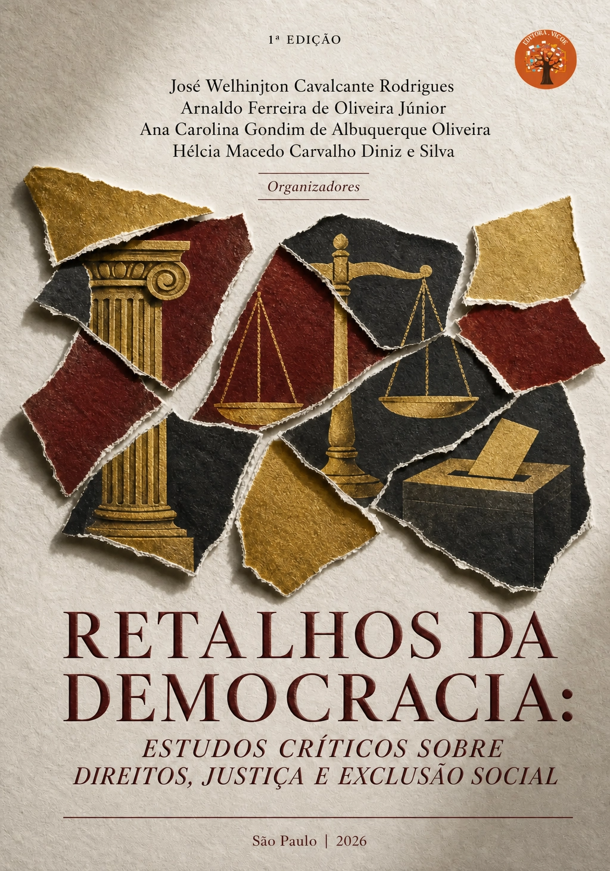
It is with great pleasure that we present the book “Patches of Democracy: Critical Studies on Rights, Justice, and Social Exclusion,” co-edited by Professor Dr. José Welhinjton Cavalcante Rodrigues and Master’s student Arnaldo Ferreira de Oliveira Junior. This is a collective work comprising 11 chapters, resulting from the efforts of researchers and Master’s students from Class 10 of the Master’s Program in Legal Sciences at Veni Creator Christian University, developed within the course “Political Development: Rule of Law, Democracy, and Citizenship,” offered during the 2025.2 semester.
The texts that make up this book emerged from genuine concerns and extensive academic debate. Although it is a work written by many hands, the chapters form a harmonious whole, constituting an invitation and a provocation to reflect on important and challenging issues facing contemporary society, since “democracy,” “social justice,” and “social exclusion” are expressions that became widespread in Brazil, particularly following the country’s redemocratization and the enactment of the Federal Constitution in the 1980s. They are widely used by government officials, journalists, politicians, legal scholars, professors, social scientists, and many others. At first glance, these expressions may seem easy to understand; however, they are imbued with epistemological complexity and depth and raise important questions, such as: what place do historically excluded people occupy in Brazilian democracy, including women, children and adolescents, racialized people, people who use psychoactive substances, and people with dissident gender identities, among many others?
The chapters were developed with scientific rigor, grounded in solid theoretical foundations, highlighting dialogues with thinkers such as Judith Butler, Michel Foucault, Nancy Fraser, Marcia Tiburi, Lélia Gonzalez, Luziana Ramalho, and others, as well as empirical data demonstrating the urgency of the issues addressed.
In the first chapter, “Between Silence and the Norm,” Maria da Conceição de Moraes and Alexandre Barbosa analyze the relationship between silence, norms, and power in the discursive dynamics of contemporary societies.
In the second chapter, entitled “Law, Patriarchy, and Vulnerability: A Critical Analysis of Acquittal in the Crime of Rape of a Vulnerable Person Based on the Application of Distinguishing,” the authors Andréa Tavares Colaço de Souza, Juliana Vieira de Barros, and Professor José Welhinjton Cavalcante Rodrigues analyze a decision handed down by the Court of Justice of Minas Gerais (TJMG). The decision overturned a conviction and acquitted a 35-year-old man of the crime of rape against a 12-year-old girl. The authors investigate whether the normative interpretation and the use of procedural tools, particularly distinguishing, were legitimately employed or whether they served to normalize and maintain structures of oppression, thereby undermining the legal protection that should have been afforded to the victim.
In the third chapter, “Precarity, Vulnerability, and Digital Exclusion: Connectivity as Unequal Infrastructure in Contemporary Society,” Rogério Machado Araújo investigates, from the perspective of Judith Butler’s theory of precarity, whether the absence of or limited access to the internet constitutes a contemporary form of social precarization.
In “Gender, Power, and the Challenges of Freedom,” the fourth chapter, written by Gláucia Daiane Ferreira Monteiro and Lilian de Souza Leão Gomes de Albuquerque, the authors present a literature review on gender, power, and the State, seeking to identify the challenges historically faced by women in relation to freedom.
In the fifth chapter, authored by Eugenio Pacelli Barbosa de Melo Porto, Gabriela Cireno Cavalcanti de Cerqueira, and Professor José Welhinjton Cavalcante Rodrigues, entitled “Harm Reduction, Biopolitics, and Drug Policy in Brazil: Between Care and the Management of Populations,” the authors analyze the role of harm-reduction strategies within the logic underlying drug policy in Brazil. They examine their potential, possibilities, and limitations in a possible transformation of punitive rationalities, as well as seek to understand “to what extent such strategies constitute effective shifts in the current model or merely internal reconfigurations of the same logic of control that underlies the current Penal State model.”
In the following chapter, “The Social Construction of the Feminine and Its Effects on the Realization of Citizenship,” Mônica Araújo de Lima and Aíde de Araújo Barros discuss how the social construction of femininity affects the realization of women’s citizenship within the Democratic Rule of Law. In the seventh chapter, Raphael Albuquerque Fernandes, Raquel Tavares Miranda Maciel, and Professor José Welhinjton Cavalcante Rodrigues examine the legitimacy of the Judiciary, considering its counter-majoritarian nature and the phenomenon of the judicialization of politics. The authors argue that, although the Judiciary is not an elective institution, “its democratic legitimacy does not depend exclusively on the legal correctness of its decisions, but also on its institutional capacity to reflect social plurality, especially in contexts marked by structural inequalities.”
In the eighth chapter, entitled “Gender Identity and Legal Recognition: Challenges to Democratic Citizenship,” Rosângela Maria M. de Araújo and Maria do Socorro Mendes de Araújo seek to understand how the law contributes to creating conditions for social recognition, highlighting the challenges to consolidating inclusive citizenship, particularly in a society marked “by profound inequalities and historically exclusionary normative standards.”
Next, in the ninth chapter, Professor José Welhinjton Cavalcante Rodrigues and Master’s students Daniel Pimentel Pinheiro and Tiago Martins Freire, in “The Jeffrey Epstein Case as a Paradigm of Contemporary Penal Selectivity,” address the Epstein case, questioning to what extent this situation demonstrates the selectivity of the criminal justice system and how such selectivity disproportionately affects women in situations of social vulnerability, producing impunity and revictimization.
In the penultimate chapter, Professor José Welhinjton Cavalcante Rodrigues and Marcelo Dias Souza conduct an investigation into possible advances that may point toward approaches to preventing and addressing the various forms of gender discrimination that violate women’s human dignity. The chapter is entitled “Punishment, Criminality, and Feminism.”
Finally, the eleventh chapter, entitled “Addressing Domestic and Family Violence as a Guarantee of the Protection of the Rights of Children and Adolescents,” was conceived by Rozeane Leal do Nascimento and Professor José Welhinjton Cavalcante Rodrigues. In this chapter, the authors reflect on the impacts of domestic and family violence on children and adolescents, as well as on the effectiveness of the legal regulations currently in force. This topic is legally and socially relevant, given the increase in cases of violence, their invisibility, and the constitutionally imposed duty to protect children and adolescents.
In light of the foregoing, this work constitutes a privileged space for reflection on current and extremely necessary issues for the construction of a democratic and inclusive society, and therefore a just and egalitarian one, as established by the Constitution of the Federative Republic of Brazil (1988).
Thus, I invite you to immerse yourselves in the pages of this powerful academic work, and may its reading lead you to understand that there can be no human dignity, citizenship, or democracy without the inclusion of all people.
Downloads
Downloads
Published
How to Cite
Issue
Section
Categories
License
Atribuição CC BY
