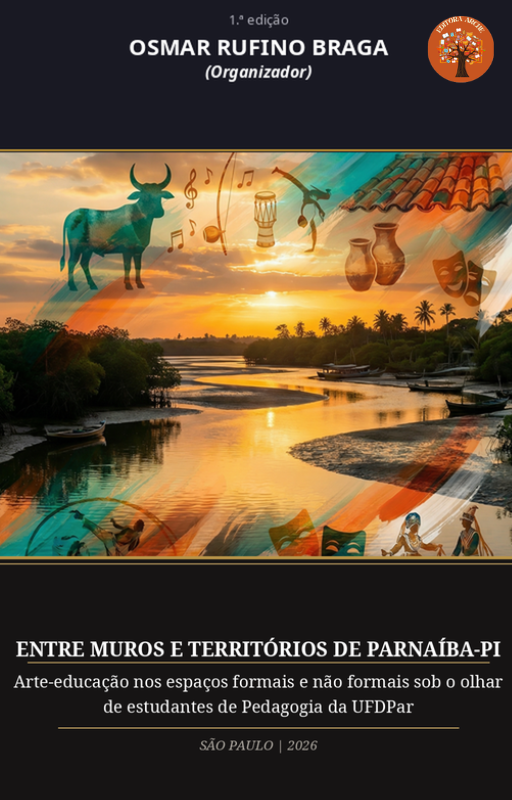
BETWEEN THE WALLS AND TERRITORIES OF PARNAÍBA (PI) ART EDUCATION IN FORMAL AND NON-FORMAL SPACES FROM THE PERSPECTIVE OF PEDAGOGY STUDENTS AT UFDPAR
Keywords:
Art Education. Non-Formal Education. Territory. Community Practices. Human Development.Abstract
It is worth recognizing, from the outset, that this book arises from the intertwining of experience, training, and territory. We are talking about what is learned in the encounter with the other, with the community, with the local culture, and also in the gesture of giving back to the world, in the form of reflection, that which crosses us, that which enchants us, but also that which challenges us and invites us to investigation, to critical-reflective analysis.
The following pages are the result of a semester of training that was constituted not only as an academic activity, but as an investigative and sensitive movement, in which students of the Pedagogy Course at the Federal University of Delta do Parnaíba, in the experiences and activities in the context of the Art-Education Curricular Component, in the second semester of 2025, were willing to look at art-education in Parnaíba (PI) as a living, plural field deeply rooted in the community and school practices of the city.
This book chooses, as its horizon, to understand art not as a curricular accessory, much less as a technique alien to life, but as a formative force, capable of arousing belonging, criticism, autonomy, and social transformation. Thus, the studies gathered here assume art education as a dimension that transcends boundaries: it takes place between the formal and the non-formal, between the school and the street, between the institution and the territory, between the subject and their community. And it is precisely in this intersection that inspiring practices, structural challenges, creative reinventions, and unique ways of making art a pedagogical and emancipatory device are revealed. But it also reveals how the Brazilian state, whose closest public entity to the population is the municipality, the municipal administration, understands and invests in art education. I invite you, reader, to perceive this reality in the works of the authors organized here.
The first chapter opens this journey by investigating, together with the NGO Amigos Solidários, how artistic practices in a community context, even in the face of material limitations, become a place for identity affirmation and the strengthening of bonds. The work reveals that, there, art operates as a gesture of welcoming and social mobilization, enabling children and mothers to find, in artistic expression, a space to rework their experiences, build self-esteem, and participate in a community fabric that is established precisely by the power of creation.
The second chapter moves to Casarão da Esperanza, another non-formal learning space, and expands the debate by showing how art education becomes a language of resistance, dialogue, and emancipation. The analyses, inspired by Freire, Read, Dewey, Bakhtin, and Ana Mae, reveal that, in that context, art not only sensitizes: it calls for participation, promotes civic awareness, and invites individuals to reinvent their ways of reading and acting in the world. Creativity, far from being an isolated skill, emerges as a political practice — a way of existing in community.
The third chapter shifts the focus to the school, examining, at SESC – Centro Educacional Elizeu Martins, how art education reinvents itself in the absence of the specialist teacher. The study shows that, when the teacher assumes an investigative, dialogical and open-minded stance, art expands beyond technique, becoming an interdisciplinary experience articulated with socio-interactionism, local culture and the daily lives of children. In this scenario, the multi-skilled teacher becomes a mediator of meanings, and the classroom is transformed into a space for creation and critical reading of the world, reaffirming, in the Freirean manner, education as a practice of freedom.
The fourth chapter leads us to follow art education in a municipal school in Parnaíba, showing that the appreciation of student culture can become a structuring axis of pedagogical practice. Even in the absence of a systematized curriculum plan, the teacher studied creates sensitive strategies to bring art, community and daily life closer together. It values local knowledge, calls students to dialogue, and broadens the notion of art to include their memories, narratives, and ways of seeing the world. Here, teacher creativity acts as a force of resistance and affirmation: it is in the teacher's inventive gesture that the community's culture finds space for reverberation and dignity.
The fifth chapter invites us to enter into the experience and art practices of the Association of Parents and Friends of Exceptional Children (APAE) of Parnaíba, where it shows its mobilizing and productive force of autonomy, dignity, and citizenship. The authors' text reveals how artistic creation, between theater, dance, and papier-mâché, weaves new forms of existence for those assisted. Under the lights of Freire, Ferreiro, and Montessori, the research reveals a pedagogy of encounter, where the engagement of the team and the welcoming of mothers in their artisanal knowledge They transform the institution into a territory of poetic resistance and authentic inclusion.
In the sixth chapter, the authors focus on the grounds of the Frei Rogério de Milão School to investigate art as an axis of human and sensitive formation. In this part, the text unveils, with lucidity and poetry, the contrasts between structural challenges, such as the lack of specific training and teaching resources, and the resilience of practices that seek to break disciplinary boundaries. The chapter draws attention to how the school assumes interdisciplinarity as a guiding principle of pedagogical work with art and how this articulates with the school's broader projects, especially the reading and writing project, which involves all disciplines.
Thus, each chapter, in its own way, reaffirms that art education, in the field of NGOs, public schools, community institutions or educational centers — is always traversed by a profound movement of subjectivation and cultural construction. Art not only transforms: it reveals. It reveals the city, reveals the individual, reveals the community, reveals what can be reinvented when education and sensitivity meet.
This book, therefore, does not present itself as a list of works, the result of visits to schools, NGOs and communities and isolated diagnoses, but as a plural tapestry of perspectives. The texts gathered here show that art, when understood as a living and situated experience, becomes the ethical and political foundation of human formation, calling us to think about education not only for what it transmits, but for what it awakens, provokes and creates.
May this work, born from concrete experiences and lived practices, inspire educators, researchers, students and all people who believe that art is a gateway to social transformation and also to a sensitive encounter with oneself and with the other, with the community.
Osmar Rufino Braga
Downloads
Downloads
Published
How to Cite
License
Atribuição CC BY
