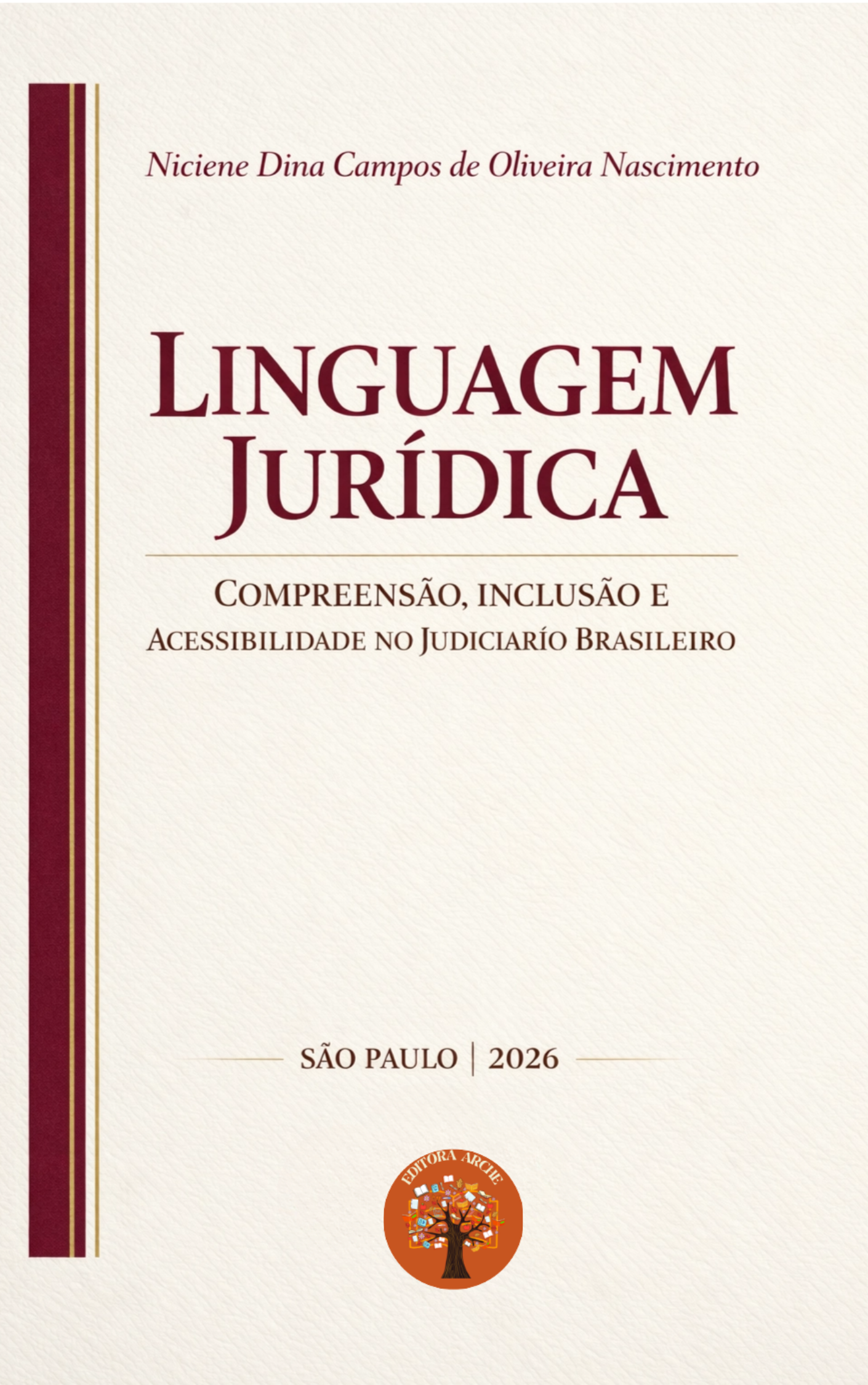
LEGAL LANGUAGE: UNDERSTANDING, INCLUSION AND ACCESSIBILITY IN THE BRAZILIAN JUDICIARY
Keywords:
Communication and understanding. Legal language. Inclusion and accessibility. Jurisdictional provision. Simplification of legal discourse.Abstract
The book investigates the complexity of legal language and how it can become an obstacle to the democratization of access to justice, with an emphasis on the critical analysis of the textual genres that permeate the legal sphere. Based on the premise that technical and ornate language, marked by archaisms, Latinisms, and redundancies, creates a communication barrier between the judiciary and the population, the study proposes linguistic simplification as a mechanism for inclusion and access to justice. The research is structured around the analysis of legal textual models—such as petitions, rulings, warrants, and judgments—considered central instruments in procedural dynamics. It draws on theorists such as Bronckart, Kleiman, and Koch (reading comprehension and textual genres), as well as Marcuschi (2008b), who defines genres as “dynamic, socio-historical, and variable,” highlighting that these texts, although specialized, must balance technical rigor and clarity to ensure communicative effectiveness. The analysis reveals that features such as excessive formalism, intricate syntax, and the adoption of overly technical terms—when there are viable equivalents in formal and clear language—hinder reading comprehension, especially for those not versed in law. Methodologically, the work adopted a qualitative approach, combining a literature review—drawing on authors such as Bakhtin, Van Dijk, and Grice—with documentary analysis of judicial documents. Throughout the study, complicating elements were identified, such as redundancy (e.g., the expression “unknown and unspecified location”) and the use of jargon that undermines the referential function of language. The research also examined contemporary initiatives, such as Visual Law and the National Pact for Plain Language of the CNJ, which seek to integrate visual elements and lexical simplification to make legal texts more accessible. Ultimately, it was concluded that the reformulation of legal textual genres—guided by clarity, conciseness, and multimodal resources, and taking into account the interdisciplinarity of the sciences—is essential to reduce informational asymmetries. In this regard, the dissertation argues that linguistic transparency not only brings citizens closer to the judiciary but also strengthens democracy, aligning with constitutional principles of access to information and equality before the law. The proposal for simplification, therefore, emerges not as vulgarization, but as an ethical strategy to ensure the right to justice.
Downloads
Downloads
Published
How to Cite
License
Atribuição CC BY
