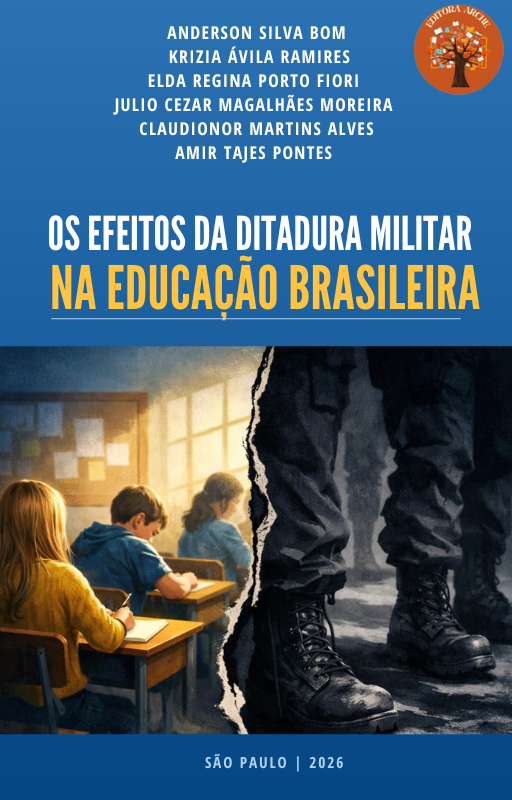
THE EFFECTS OF THE MILITARY DICTATORSHIP ON BRAZILIAN EDUCATION
Keywords:
Ditadura Militar. Os efeitos da Ditadura Militar na educação do Brasil. Avanços e retrocessos educacionais pós Ditadura Militar.Abstract
Brazilian education has undergone multiple transformations throughout history, marked by specific advances and significant setbacks that, at many times, have contributed to the stagnation of the educational process. Within this historical context, the Military Dictatorship (1964–1985) represents a period of profound political, ideological, and structural interference in the educational field, the effects of which can still be perceived in contemporary times. Given this reality, this work proposes to discuss how the military dictatorship affected Brazilian education, seeking to understand the changes that occurred during this period, as well as the advances and setbacks that followed over time.
The central objective of the research is to analyze the impact of the military dictatorship on national education, identifying the setbacks caused by authoritarian policies, while examining the transformations implemented and their repercussions in the current educational scenario. The investigation stems from the understanding that the military regime imposed a centralizing, technocratic, and ideologically controlled logic on education, oriented more towards maintaining order and conservative morality than towards the critical and emancipatory formation of individuals. In this context, teachers and students were subjected to repression, censorship, and persecution, which compromised academic freedom, critical thinking, and democratic participation in the school and university environment.
The choice of the theme is justified by the need to deepen the understanding of the historical effects of the military dictatorship on Brazilian education, as well as to promote dialogue with different authors who analyze this period from different theoretical perspectives. By bringing these discussions to the academic environment, the aim is to contribute to critical reflection on the paths taken by education in Brazil and on the challenges that still persist. The research is based on a bibliographic methodology, using recognized authors and reliable sources, such as CAPES databases, Google Scholar, SciELO, and scientific journals, including publications from the last ten years. This is a qualitative study that prioritizes the theoretical and interpretative analysis of the effects of the military dictatorship on Brazilian education.
The results show that the educational transformations that occurred during and after the military regime were, for the most part, abrupt and conducted by agents distant from the reality of schools, which contributed to the weakening of pedagogical autonomy and the participation of education professionals in decision-making processes. Despite the discourse of modernization and expansion of education, the period was marked by a less democratic educational model, in which teachers, although directly involved in the daily life of schools, were excluded from the formulation of laws, decrees, and educational projects, being limited to complying with determinations imposed in a top-down manner. Furthermore, professional devaluation, expressed in low salaries and precarious working conditions, has become a negative legacy of this historical period.
It is concluded, therefore, that the military dictatorship exerted a significant influence on Brazilian education, leaving deep marks that still reverberate in educational policies and the organization of the education system. The analysis of this period reveals the importance of strengthening a democratic, participatory education committed to critical thinking, in which teachers and students have an active voice in building an educational project that meets the real needs of society.
Downloads
Downloads
Published
How to Cite
License
Atribuição CC BY
