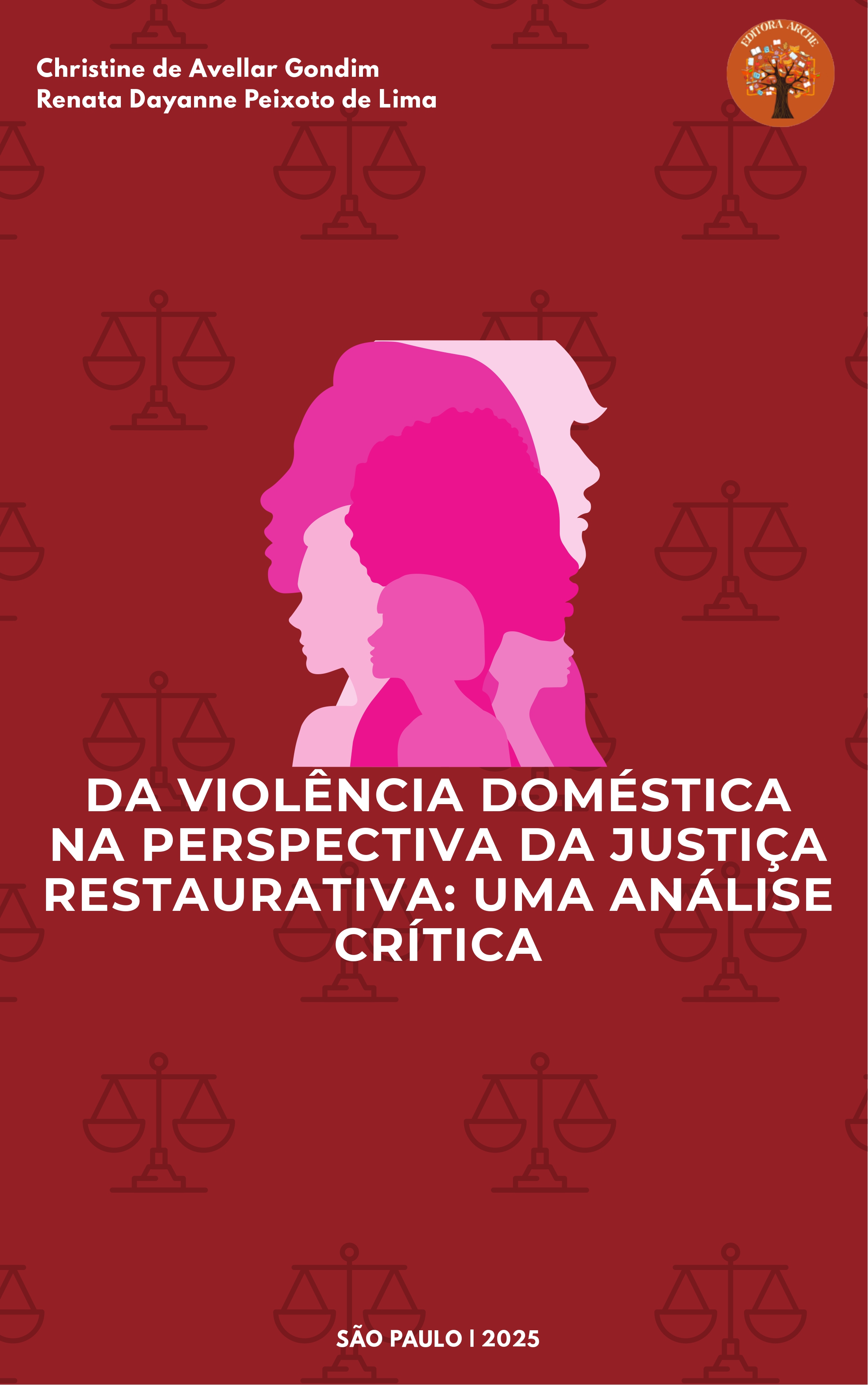
DOMESTIC VIOLENCE FROM THE PERSPECTIVE OF RESTORATIVE JUSTICE: A CRITICAL ANALYSIS
Keywords:
Restorative Justice. Maria da Penha Law. Criminal Mediation. Recidivism. Domestic Violence.Abstract
Domestic violence against women is an issue of profound social and legal relevance that demands a detailed and multifaceted approach. This study aims to explore restorative justice as a potential solution to this persistent problem, highlighting its potential to promote healing and rebuild social relationships. Contextualizing domestic violence in Brazil, considering historical, cultural, and legislative aspects, is essential to understanding the need for new approaches that complement traditional measures. Data from the Brazilian Public Security Forum (2023) indicate that domestic violence remains one of the main forms of human rights violations in the country, reinforcing the urgency of discussing more effective alternatives for addressing these situations.
In the legal field, restorative justice, an alternative to the traditional punitive model, emerges as a proposal that aligns with the ethics of singularity, allowing for the creation of a justice system more tailored to the needs of victims and offenders.
According to Howard Zehr (2005), this involves a "change of lenses" through which crime is seen as an intersubjective conflict, not simply as a violation of the law. This involves considering the needs of all parties involved, promoting dialogue between them, and seeking solutions that empower participants. Furthermore, this approach aims to create a safe environment for victims to express their concerns, while encouraging offenders to acknowledge and repair the harm caused.
The institution of crime, from this perspective, is understood as a transgression that affects the offender, the victim, and the community. Justice, therefore, must acknowledge the harm caused, both material and emotional, and offer mechanisms for its reparation. Restorative practice, unlike retributive punishment, seeks to restore relationships between the parties, fostering a space for dialogue and cooperation.
A recent study by Souza and Andrade (2021) demonstrated that restorative justice programs applied to domestic violence cases in the Northeast region of Brazil had a positive impact on reducing recidivism among offenders and strengthening victims' autonomy.
Within this context, the Brazilian judicial system has struggled to achieve its fundamental justice objectives, requiring improvements to prevent private revenge, a worrying practice observed in contemporary society.
Restorative Justice offers an innovative alternative by moving away from an exclusive focus on punishment, proposing a focus on reestablishing bonds and strengthening the autonomy of the parties involved. Instead of treating the offender as a criminal, the term "offender" is used to reflect a more humanized conception of the person who committed the offense.
Howard Zehr (2005), in his seminal work on Restorative Justice, argues that crime should be understood as a rupture of social bonds, and the response should be the rebuilding of these bonds, with the active participation of victims, offenders, and communities. Applying this approach to the context of domestic violence has the potential to create an environment where victims can not only obtain redress but also feel safe and respected.
International studies, such as those by Morris (2005) and Marshall (2005), show that Restorative Justice, when applied appropriately, promotes the transformation of relationships and the reduction of violence.
The hypotheses outlined for this study are based on the premise that restorative justice can provide a safer and more welcoming environment for victims of domestic violence, while also reducing recidivism among offenders. The first hypothesis suggests that by actively participating in the restorative process, victims feel more empowered and are thus able to express their needs more clearly.
The second hypothesis is that restorative justice, by promoting accountability for offenders and facilitating reparations, significantly contributes to reducing the recidivism of violent acts.
The research question guiding this study is: How can restorative justice be effective in resolving domestic violence cases, compared to traditional justice methods? Answering this question will allow for a comparative analysis between the restorative and punitive models. That is, it will be possible to observe how each model—restorative and punitive—applies in practice to domestic violence. This comparative analysis will seek to identify differences in their objectives, methods, and impacts. The aim is to understand which approach best meets the needs of victims and holds offenders accountable. This reflection is essential to assess the effectiveness of each system.
This analysis will be conducted from a critical perspective, taking into account not only the formal outcomes of the processes but also the social and emotional impacts produced by each justice model.
The relevance of this study lies in the urgent need to identify new ways to address domestic violence in Brazil. As suggested by Pinto de Vitto (2005), it is necessary to rethink the role of the justice system in mediating these conflicts, adopting more humane practices that take into account the particularities of each case.
The implementation of restorative justice programs in domestic violence cases can offer a more effective and less traumatic solution for victims, in addition to promoting a cultural shift in the treatment of these crimes.
In short, the critical analysis of domestic violence from the perspective of restorative justice offers an innovative approach to a problem deeply rooted in Brazilian society.
By reframing the crime as a conflict between parties and not simply a legal violation, restorative justice proposes a more ethical and effective solution to domestic violence, promoting the empowerment of victims and the accountability of offenders.
The results of this study can significantly contribute to the development of public policies that promote social justice and women's safety.
Regarding the content of the work, it begins with the section "An Introduction to Domestic Violence Against Women," which addresses the phenomenon of domestic violence from different perspectives. In "Gender-Based Violence and Forms of Violence Against Women," the section discusses how unequal power relations between men and women perpetuate and describe manifestations of violence. "Contemporary Violence in Gender Relations" explores the impacts of social and cultural changes on understanding power dynamics. "Chronological Evolution of Protection Against Domestic Violence" presents a historical overview of protective legislation. Finally, "The classification of domestic violence, according to the Maria da Penha Law, analyzes the relevance of this law in combating domestic violence.
The section "Restorative Justice as an Alternative in Addressing Domestic Violence in Cases of Criminal Offenses" explores restorative justice as a possible response to conflicts arising from domestic violence. The subsection "What is Restorative Justice" highlights its emergence as an alternative to traditional punitive practices.
"The Role of the Facilitator" discusses their role as an impartial mediator in the restorative process. "Practical Restorative Approaches" presents the main methods adopted. "The Brazilian Legal System and Restorative Justice" analyzes the integration of these practices into the Brazilian legal system.
The subsection "The United Nations' Request: Resolution 2002/12" highlights the importance of international support for restorative practices. Bill No. 7,006 of 2006 details the legislative proposal and the challenges faced. "Case Law on Restorative Justice" analyzes court decisions addressing the topic. The subsection "Principles of Restorative Justice" presents the theoretical foundations that underpin this approach.
Finally, "Challenges and Criticisms in the Application of Restorative Justice in Cases of Domestic Violence" discusses the barriers and possibilities for its implementation, concluding these discussions with reflections on its social relevance.
The final section, "Results and Discussions," brings together the main data and analyses developed throughout the work. This section examines the challenges and advances of restorative practices in addressing domestic violence, proposing reflections and solutions that integrate the perspectives discussed in the previous sections.
OBJECTIVES
General Objective
Critically analyze the effectiveness of restorative justice as an alternative approach to resolving domestic violence cases, compared to traditional justice methods, highlighting its potential to promote reparation, reduce offender recidivism, and protect victims.
Specific Objectives
Identify the main challenges and limitations faced in implementing restorative justice programs in domestic violence cases.
Evaluate the impact of restorative justice in reducing offender recidivism compared to traditional methods.
Analyze how restorative justice can contribute to the protection and empowerment of victims of domestic violence, providing a safer and more welcoming environment.
Examine the applicability of restorative justice in the Brazilian context, taking into account cultural, social, and legislative aspects. Propose improvements and recommendations for the implementation of Restorative Justice programs in Brazil, with a focus on effectiveness and protection of the parties involved.
Downloads
Downloads
Published
How to Cite
License
Atribuição CC BY
