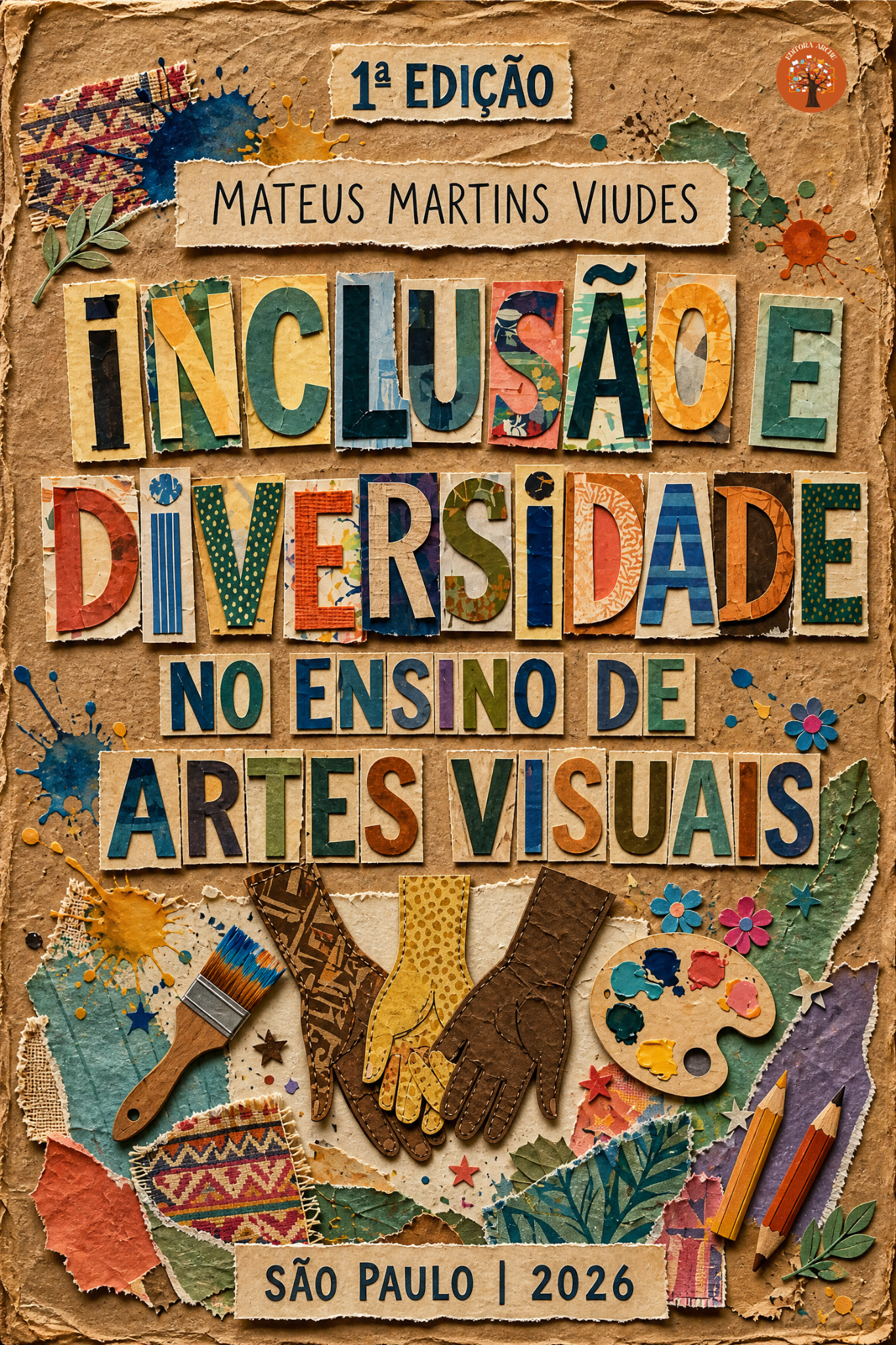
INCLUSION AND DIVERSITY IN VISUAL ARTS EDUCATION
Keywords:
Visual Arts. Diversity. Inclusive Education.Abstract
This e-book was designed for visual arts teachers, pre-service teachers, special education professionals, pedagogical teams, and other educators committed to creating accessible artistic experiences. Its purpose is to discuss how inclusion and diversity can guide planning, mediation, creation, appreciation, and assessment in visual arts education.
The perspective adopted here views inclusion as a transformation of educational conditions, rather than merely placing students into pre-established practices. This requires identifying and addressing physical, communicative, informational, curricular, technological, and attitudinal barriers. Disability is not treated as an isolated explanation for participation difficulties; instead, the focus is on the relationship between individuals' characteristics and the environments that can either restrict or expand their possibilities (MANTOAN, 2015; BRASIL, 2015).
In the field of visual arts, this commitment entails recognizing diverse ways of perceiving, producing, and communicating images. Artistic reading, contextualization, and creation must engage with diverse cultural repertoires, accessible materials, assistive technologies, and multiple forms of expression. Uniqueness does not diminish the quality of the aesthetic experience; rather, it expands the questions, languages, and meanings constructed collectively (BARBOSA, 2014; REILY, 2010).
The chapters address foundational concepts, barriers to participation, student variability, curriculum, strategies, teacher training, artistic practices, public policies, family engagement, and future perspectives. The proposals in Chapter 8 are pedagogical possibilities that can be adapted to specific contexts, rather than reports on field research or ready-made models. At the end of each chapter, reflection questions support dialogue and the reimagining of practices.
Downloads
Downloads
Published
How to Cite
License
Atribuição CC BY
