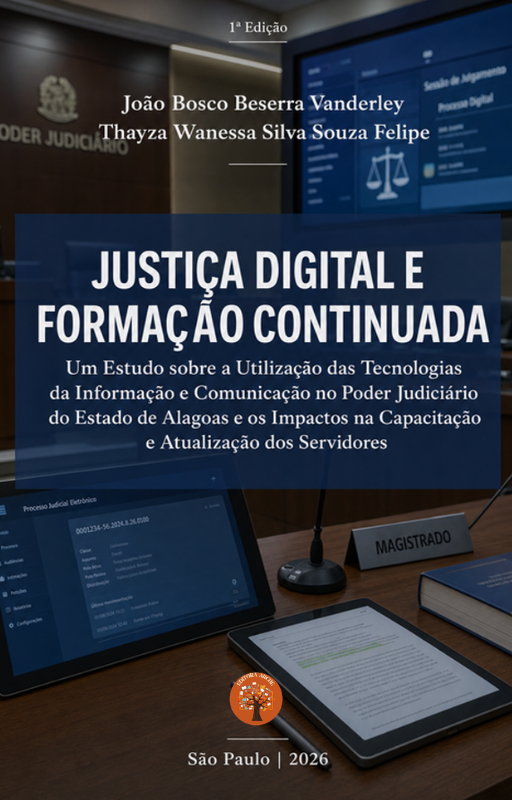
DIGITAL JUSTICE AND CONTINUING EDUCATION: IMPACTS OF TECHNOLOGIES AND TRAINING ON THE PERFORMANCE OF COURT OFFICERS IN THE DISTRICT OF CARUARU/PE
Keywords:
Digital Justice. Continuing Education. Professional qualification. Digital Technologies. Public Service.Abstract
This study aims to assess how continuing education and the use of technological tools impact the functional performance of public servants responsible for carrying out judicial activities within the Brazilian Judiciary. The research is guided by the following central question: how have the digitalization of the judicial system and continuing education programs affected the functional performance of civil servants in the judicial district of Caruaru/PE, considering the challenges and potentialities of this specific territorial context? The specific objectives are to analyze the current landscape of continuing education and the use of digital technologies, to examine the relationship between the adoption of these tools and operational efficiency in daily tasks, and to investigate the interests, perceptions, and possible resistance to technological innovations and institutional training programs. Methodologically, this is a field study, descriptive and exploratory in nature, conducted using a mixed-methods approach that combines both quantitative and qualitative dimensions. The empirical field was the Judicial District of Caruaru/PE, and the participants were active public servants. Quantitative data were analyzed using descriptive statistics, while qualitative data were treated through content analysis, according to Bardin (2011). The findings indicate that digitalization has had predominantly positive effects, especially in terms of increased productivity, procedural speed, and the reorganization of work routines. Tools such as WhatsApp, Google Maps, and PJe were reported as widely used, whereas more advanced resources,like artificial intelligence and videoconferencing platforms,emain underutilized, revealing a selective process of technological appropriation. Regarding continuing education, participation was found to be low, not due to individual resistance, but because of a lack of institutional offerings and insufficient alignment of course content with the practical demands of the job. It is concluded that the effectiveness of Digital Justice is directly linked to the implementation of structured continuing education policies that are sensitive to local realities and aligned with the concrete working conditions of the staff. This research contributes to the field of Education by demonstrating that digital transformation in the public sector requires not only technological investment but also critical, contextualized, and ongoing training processes. Such processes are essential for promoting digital literacy, strengthening professional autonomy, and improving the quality of public service delivery.
Downloads
Downloads
Published
How to Cite
License
Atribuição CC BY
