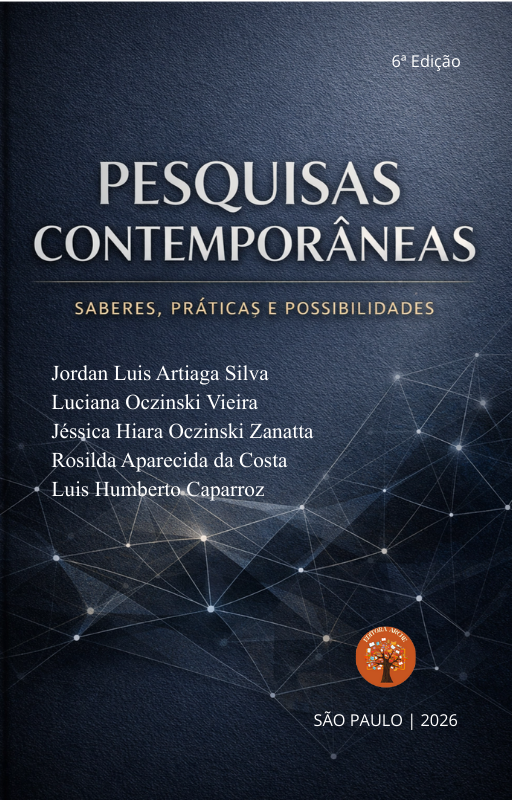
CONTEMPORARY RESEARCH: KNOWLEDGE, PRACTICES AND POSSIBILITIES
Keywords:
Pedagogical Innovation. Educational Technologies. Quality Management.Abstract
This work brings together contemporary reflections and practices on education, technology, management, and pedagogical innovation, proposing an integrated view of the challenges and possibilities that permeate the current educational landscape. Throughout the chapters, the reader is invited to understand how different theoretical and methodological approaches can contribute to the qualification of teaching and learning processes, as well as to the improvement of educational management.
The collection begins by discussing Artificial Intelligence in teaching and learning processes, highlighting its applications, potential, and pedagogical implications in the educational context. In dialogue with this innovative perspective, the chapters that address the PDCA method applied to education highlight the importance of planning, organization, and quality management, demonstrating how this method can be used both in educational planning and in institutional practice.
The work also emphasizes collaborative learning and active methodologies, presenting them as essential paths to a transformative education, centered on the student and the collective construction of knowledge. Along the same lines, the importance of interaction and collaboration in education is discussed, analyzing collaborative tools that enhance engagement and meaningful learning. The challenges faced by teachers in contemporary times are extensively explored, especially regarding the integration of new technologies into the curriculum and teacher mediation in the digital age. These chapters reflect on the resistance, difficulties, and possibilities of the pedagogical use of emerging technologies, reinforcing the teacher's role as a mediator, innovator, and agent of transformation.
Another relevant axis of the work deals with educational trends, with emphasis on e-learning, analyzing the teacher's role in the face of new formative demands and virtual learning environments. Complementing this discussion, the work addresses the contributions and challenges of using assistive technology for students with visual impairments, reaffirming the commitment to inclusive education and the right to equitable access to knowledge.
In an interdisciplinary way, the work also presents an in-depth theoretical reflection by discussing justice as narrative, based on constructive hermeneutics and the aesthetic dimension in Dworkin's theory, expanding the educational debate beyond pedagogical practice, reaching ethical, legal, and interpretative aspects of education. Finally, the collection concludes with an analysis of quality management in educational institutions, highlighting strategies and principles that contribute to the promotion of efficient, democratic, and socially committed education.
Thus, this work constitutes essential reading for teachers, managers, researchers, and students in the field of education interested in understanding and transforming educational practices in light of innovation, inclusion, collaboration, and educational quality.
Given the reflections presented, this work is configured as a space for dialogue, knowledge building, and re-signification of educational practices. By articulating theory and practice, innovation and management, technology and inclusion, the work invites the reader to rethink the role of education in a constantly transforming world.
We invite you to go through each chapter with a critical and reflective eye, allowing yourself to question, learn, and reinvent your own pedagogical and institutional practices. May this reading inspire new ideas, strengthen the commitment to quality education, and contribute to the construction of more collaborative, inclusive, and innovative paths.
Happy reading!
Downloads
Downloads
Published
How to Cite
License
Atribuição CC BY
