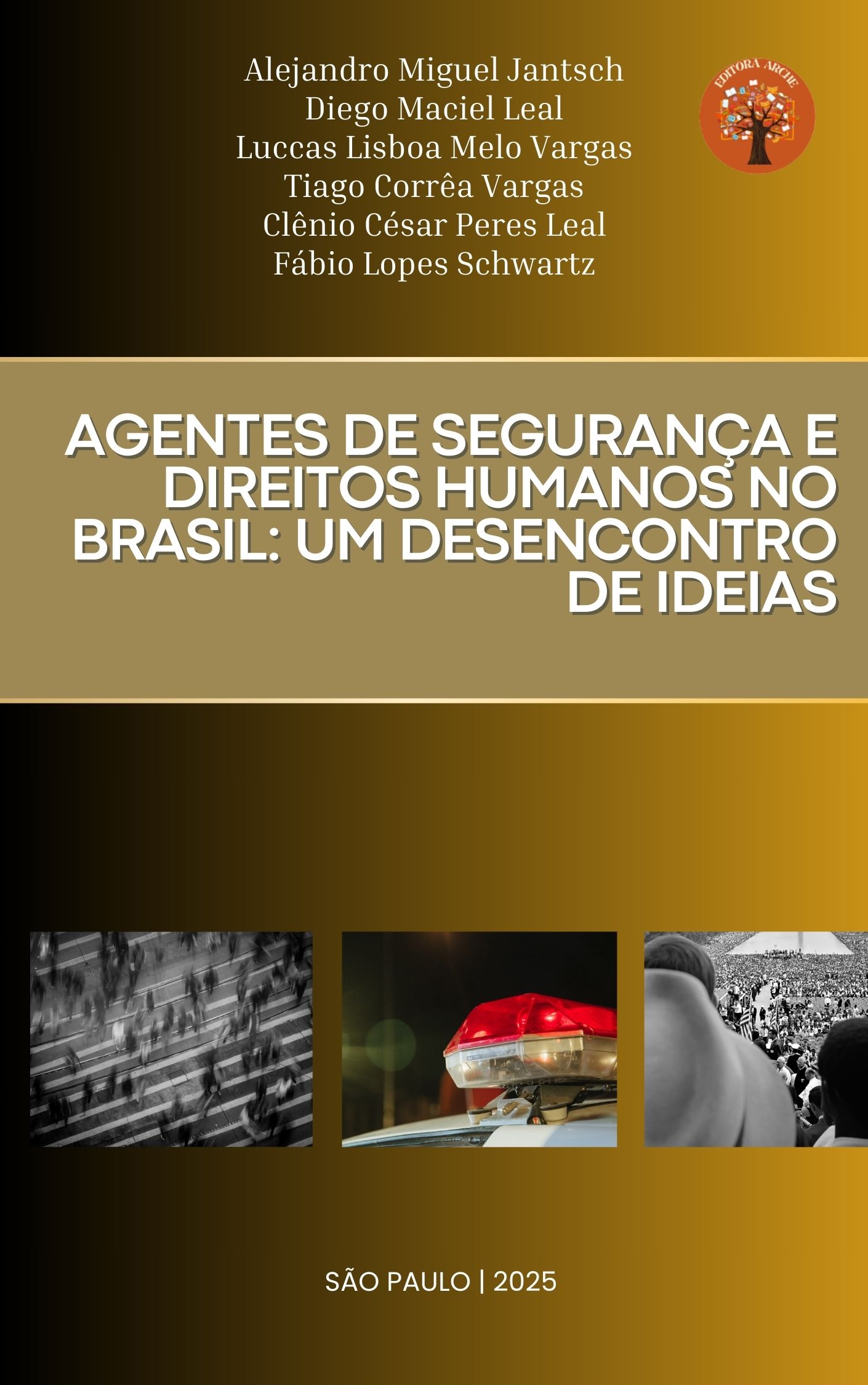
SECURITY AGENTS AND HUMAN RIGHTS IN BRAZIL: A MISMATCH OF IDEAS
Keywords:
Military Police. Human Rights. Deaths. Training.Abstract
It is with great pleasure that we present the digital book Security Agents and Human Rights in Brazil: A Mismatch of Ideas, a work that aims to explore, in depth and critically, the complex relationships between the actions of public security agents and the fundamental principles of human rights in the Brazilian context. This book is an invitation to reflect on one of the most urgent and sensitive issues in contemporary society: the tension between the need to guarantee public security and the imperative to respect and promote human rights. Brazil, a country marked by profound social and historical inequalities, faces significant challenges with regard to public security.
The actions of the police forces, often associated with cases of violence and rights violations, have been the target of intense debate and criticism. On the other hand, security agents face ethical and operational dilemmas in an often hostile and dangerous work environment.
This book seeks to analyze these issues from multiple perspectives, offering a comprehensive and balanced view of the topic. The work is organized into three interconnected chapters, each of which addresses specific aspects of the relationship between public security and human rights.
The first chapter, The Declaration of Human Rights, serves as a theoretical and historical basis for understanding the principles that guide human rights. The Universal Declaration of Human Rights, adopted by the United Nations (UN) in 1948, is analyzed in its historical context, highlighting its importance as a milestone in the fight for human dignity and social justice. The chapter explores the articles of the Declaration, with an emphasis on those that are directly related to the work of security agents, such as the right to life, liberty, and personal security. In addition, the challenges of implementing these principles in a country like Brazil, where violence and social inequality often conflict with human rights ideals, are discussed.
The second chapter, Police Action in Brazil, focuses on the reality of police action in the country. Based on statistical data, academic studies, and reports of emblematic cases, the main challenges faced by public security forces in Brazil are analyzed. The topics covered include the training of security agents, working conditions, the institutional culture of the police, and the impacts of police violence on the population, especially in urban outskirts. The chapter also discusses public security policies implemented in recent decades, assessing their successes and limitations. The analysis seeks to understand how police action can simultaneously protect and violate human rights, depending on the circumstances and practices adopted. The third chapter, “Between the Duty to Protect and the Stigma of Violence: Public Security and Human Rights in Brazil,” delves deeper into the discussion on the tension between the duty to protect society and the stigma of violence that often falls on security agents. The chapter explores the ethical dilemmas faced by police officers and other professionals in the field, who must reconcile the need to combat crime with respect for the fundamental rights of citizens. The chapter also addresses the role of the media, public opinion, and human rights organizations in constructing the image of security agents, which is often associated with violence and arbitrariness. Finally, reflections are proposed on possible ways to overcome the mismatch of ideas between public security and human rights, suggesting measures that can promote a culture of peace and social justice. Security Agents and Human Rights in Brazil: A Mismatch of Ideas does not intend to offer definitive answers, but rather to stimulate debate and reflection on a topic of extreme relevance to Brazilian society.
The work is intended for students, researchers, professionals in the area of public security, human rights activists and all those interested in building a fairer and safer country. Throughout the chapters, the reader will be invited to question prejudices, confront uncomfortable realities and consider new perspectives on the relationship between public security and human rights. We believe that only through dialogue and mutual understanding will it be possible to overcome the challenges that separate these two seemingly antagonistic, but essentially complementary, fields. May this work contribute to broadening the debate and inspiring concrete actions in favor of a more humane and safer society.
Enjoy your reading!
The authors,
Downloads
Downloads
Published
How to Cite
License
Atribuição CC BY
